
Por Nick Estes
 |
Historians are supposed to draw lessons from the past. And despite their professed allergy to “presentism,” contemporary biases nonetheless seep into all historical narratives, no matter the declared “objectivity” of the storyteller. The Lakota oral tradition is no different.
In To You We Shall Return, Lakota writer Joseph Marshall turns to his childhood, the postwar years when he was raised by his paternal grandparents on a plot of land overlooking the White River on the Rosebud Reservation. It is almost a trope that this specific era, with its images of dusty reservation roads and hardships of eking out an enforced life in rural isolation as farmers and cowboys, has also been defined as the halcyon days for a generation of Lakotas. As with all nostalgia, there is a mix of truth and romanticism of a simpler time that inevitably glosses over complex social realities and hardships.
When he is not recounting the episodes of the last truly free generation of our people, who like their buffalo kin were not bound in thought or spirit by the confines of artificial borders on a map, there is a corresponding reverence for mid-twentieth-century reservation life. Despite the subjugation, which had seemed so thorough by then with the loss of land and the violent transformation of the Lakota way of life, those years were also authentically Lakota. And so it was for Marshall’s childhood.
When he turns to his youthful mind’s eye, he sees a world radically different from ours, colored and textured in the language and knowledge of his ancestors. He spoke Lakota. He knew the land and it knew him as Lakota. He dreamt and wondered at the vast starry expanse of Northern Plains night skies in Lakota. He also loved and felt anger and joy in Lakota. What was perhaps trivial and mundane for him appears profoundly unfamiliar to modern readers. The sun still rose and set, but it measured a different time and cadence for a life that felt those natural rhythms far differently than the world that surrounded it.
The world beyond the reservation seemed confusing, moving at an incomprehensible speed and roaring with deafening noise. At rare moments, it penetrated Marshall’s world. The thunderous B-29 engines rumbling overhead sometimes broke a spell of tranquility. These aircraft, the same designs that carried atomic weapons to their nightmarish conclusions at Hiroshima and Nagasaki, were destined for Ellsworth Air Force Base just outside Rapid City, South Dakota. The bomber pilots looked down on a world that history seemed to have left behind. It is a curious thing that those pointing out historical anachronisms have little grasp of history itself.
Decades of wars with Lakotas resulted in the burning down and banishment of all U.S. military forts within the territory set aside by peace treaties. This changed during World War II, when the U.S. military built an Air Force base to train fighter pilots and bomber crews. Native lands and livelihoods were once again sacrificed for the nation’s war efforts. The federal government seized from Lakotas hundreds of thousands of acres on the Pine Ridge and Cheyenne River reservations, removing hundreds of Lakotas to make way for bombing and gunnery ranges on their lands. (Only recently have some of those lands been returned.)
While Marshall does not remark upon the ways U.S. militarism has transformed the landscape and shaped Lakota-U.S. relations, it is nonetheless remarkable that today the U.S. military as a standalone institution is the largest polluter and emitter of greenhouse gases on the planet—to say nothing of its role in snuffing out political alternatives and liberation movements challenging imperial hegemony. And it is a role that has shaped and continues to shape its relationship with the original peoples of this continent. It is hard to point to the excesses of American empire today—shocking as they are—and say Indigenous peoples are surprised by the outcome.
While historians typically locate the most violent periods of land dispossession and threats to Indigenous lifeways in the ill-conceived policies of a previous century, there is not the same consideration for twentieth-century federal Indian policy. And yet the struggles were equally existential. The primary threat was a Cold War liberalism that hoped to resolve two primary issues on the domestic policy front. The first aim was to resolve what had been described as the problem of “race relations,” and the second was rolling back what were seen as the excesses of New Deal policies. Federal termination policy aimed to solve both problems for American Indians, first by removing special protections guaranteed under treaties and nation-to-nation relationships and second by entirely undoing the expansion of tribal authority under the 1934 Indian Reorganization Act. Proponents couched their rhetoric in the language of the civil rights movement, pointing out that the special status of tribes and reservation lands held back full “equality” for American Indians. And they passed legislation to entice people off the reservation through federal relocation policies.
While this battle was waged at a tribal-national level, and Lakotas organized one of the most strident and successful anti-termination movements, people like Marshall’s grandparents took their struggle to the land and to raising the next generation of Lakotas. Although the world around him was in chaos and disorder, and his way of life under constant threat, the young Marshall had little concern for the atomic age of refrigerators, mass communication, and weapons of mass destruction. His world at that moment may have seemed small, living atop the plateau overlooking the White River, but it was profound, tethered to a deeper historical continuum, one that existed prior to American empire, existed as an antagonism to it, and perhaps one day will outlive it.
This piece first appeared on Nick’s Substack.
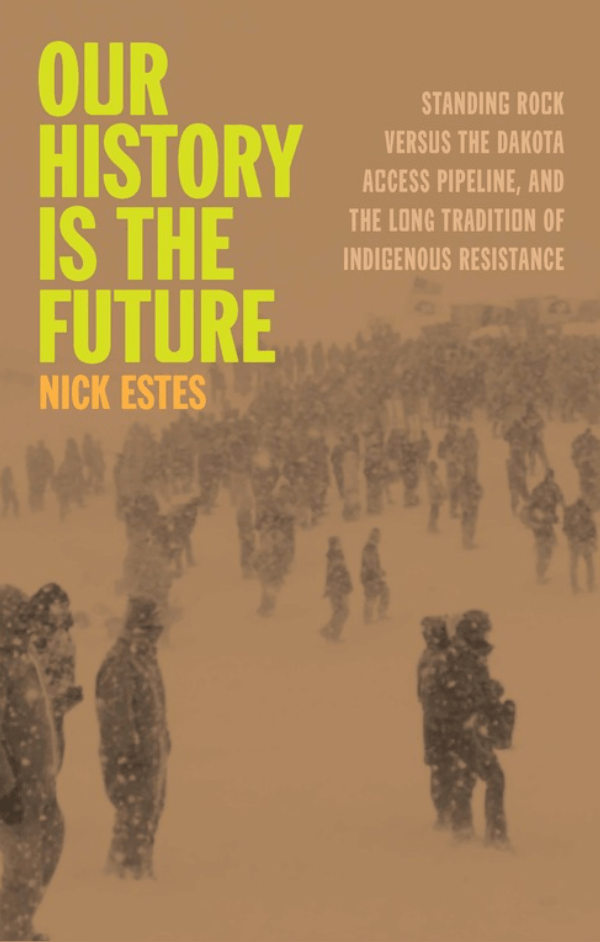
Nick Estes is a citizen of the Lower Brule Sioux Tribe. He is a journalist, historian and co-host of the Red Nation Podcast. He is the author of Our History Is the Future: Standing Rock Versus the Dakota Access Pipeline, and the Long Tradition of Indigenous Resistance (Verso, 2019).
Nenhum comentário:
Postar um comentário