
Por Stephen F. Eisenman
 |
Rearview mirror
Since the election, Trump is like the car you pass on the highway, still visible in your rear-view mirror but further away every second. But beware: “Objects in the mirror are closer than they appear.” Trump still commands the military plus ICE, his brownshirts. The Department of Justice – including the FBI – remains at his beck and call. The Supreme Court is in Trump’s pocket. The wealthiest men in the world – Musk, Bezos, Zukerberg, and Huang (naturally) – still support him.
Trump has promised to become “Mr. Veto” and derail any legislation favored by Democrats. In practice, however, the president can’t veto every bill and expect to remain relevant. At least a third of White House staffing depends upon congressional appropriation. In addition, Trump’s hold on the executive branch has been weakened; agency heads and their lawyers must exercise caution with a new Democratic Congress looking over their shoulders. Though Trump’s Justice Department will refuse to enforce Democratic subpoenas, administration attorneys could face state disbarment proceedings if they flagrantly disobey congressional requests for testimony. After Trump’s gone, they will still need to pay for their tassel loafers.
While it’s true that by appointing the malignant Steven Miller as his chief of staff, Trump is doubling down on his murderous anti-immigration campaign, the selection feels a little desperate, like Joe McCarthy hiring Roy Cohn before the Army-McCarthy hearings; it’s admission of a weak hand. I’ve recently compared Miller to Hitler’s propaganda minister, Joseph Goebbels, but a Nazi-expert friend suggested another comparison: Heinrich Himmler, the man most responsible for carrying out the Holocaust, and who regularly pledged “unconditional loyalty” to the Führer. In the end, he fled the Berlin bunker where Hitler was holed up and tried to make a sperate peace with the Americans. (After capture, he died by suicide capsule.) In front of assembled reporters in the Oval Office, Miller said to Trump: “I pledge you, Mr. President, my absolute loyalty, my unwavering commitment and my total devotion to your success and the success of this country.” Expect him too, at the end, to turn tail and run, though he’ll probably maintain his preference for mayonnaiseover cyanide.
Trump began to seem a spent force even before the Republican electoral debacle. He lost the war against Iran and may lose it again if he restarts major hostilities. His rallies are no longer well attended and his speeches – once delivered con brio – are incoherent, hesitant, and boring. He no longer frightens foreign leaders. To be upstaged, as Trump was at Davos, by the technocratic prime minister of Canada, Mark Carney, was a significant blow.
Trump clearly remains dangerous, and there will undoubtedly be some bad surprises in the next two years. But each day, week and month that passes, Trump becomes weaker and less relevant. Then, on the day designated in November 2028, after being doused with the cold water of a presidential election, he will melt and disappear like the Wicked Witch of the West. The billionaires who adored him will have to find a new love interest.
After that will come the reckoning. It’s premature to begin the detailed work of seeing Trump in retrospect, but it’s already possible to view his regime as a sum of destructions. He’s responsible for: 1) a foreign policy even more cruel and blundering than the one that came before; 2) a social safety net increasingly in tatters; 3) a Supreme Court more malign, prejudicial and corrupt than any in the last century at least; 4) global climate change accelerating ever faster toward catastrophe; 5) an economy more pitched to favor the rich than at any time since the Gilded Age; 6) a diminished civil society, with law firms, universities and non-profit organizations damaged by budget cuts, compromise and indecision; and 7) public, political communication more perverse, vulgar, and deceitful than any in living memory.
That last – the domain of ideology — may seem minor compared to the rest, but Trump’s countless prevarications are integral to everything he does. They appear in speeches, executive orders, laws, policy papers, social media postings and memes. The final one on the list – the memes – are remarkable for one thing above all, their incredible inanity. Long after Trump is dead and forgotten, his memes will be remembered. They represent The Art of the Stupid.
The presumption of meaning
We’re led to believe everything means something: A wire straightened into a pin; 20 yards of linen exchanged for a coat; the shape of a finch’s beak; a dream of flying; a myth about jaguars, a passing comment about age, ethnicity or gender. All convey political, scientific or social meaning. But what happens if someone – let’s say the president of the United States – invents or promotes ideas and images — memes — of such stupidity that analysis itself seems idiotic.

Artist unknown (pseud: @xerias_x), stills from King Trump, posted on Truth Social, October 18, 2025.
The problem is especially vexatious because the producers of these memes are largely anonymous; they sign their posts with internet tags alone. This obscuring of authorship protects them from blowback but is also a kind of humility: Memes are the product of human prompts and the ersatz imagination of AI, trained on millions of existing letter, word and image combinations, or tokens. Can machines really make meaning?
The “material bodily lower stratum”
The AI generated video called King Trump, which shows Trump as a fighter pilot dumping shit on Anti-Kings marchers below, appears to draw upon a long tradition of scatological imagery used for political purpose. The lineage may be traced to antiquity but was resurrected in early-modern Europe to mock hierarchy and encourage popular resistance to disfavored powers. References to the carnivalesque and what the Russian literary theorist Mikhail Bakhtin called the “material bodily lower stratum” appear, for example, in a series of anti-papal woodcuts by Lucas Cranach the Elder and his workshop. One, ironically titled “Kissing the Pope’s Feet,” shows Pope Paul III, enthroned between cardinal and priest, mocked by a pair of peasants who show their asses and fart. Another, labeled “The Source and Origin of Monks,” presents a demon on a scaffold shitting out a pile of tonsured monks. Both works attack papal authority on behalf of protesting (Protestant) commoners.
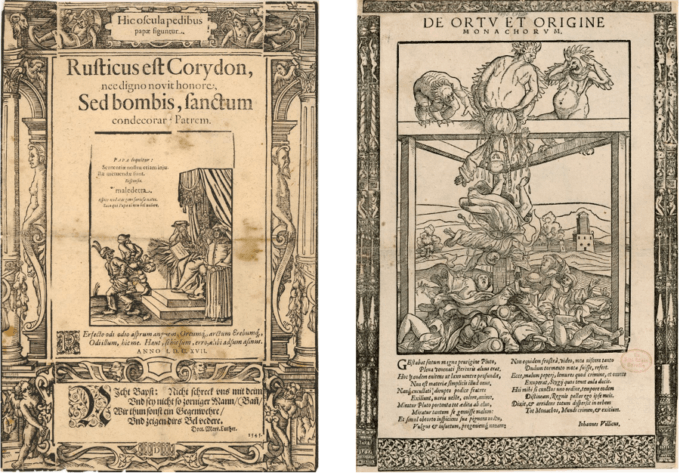
Lucas Cranach the Elder, Hic oscula pedibus papæ figuntur, 1545. London: British Library; and De ortu et origine monachorum, 1545, Staatsbibliothek Berlin.
Two and a half centuries later, this gross rhetoric was revived by the English caricaturist James Gilray. In A Voluptuary Under the Horrors of Digestion (1792), Gilray ruthlessly caricatured the Prince of Wales (the future George IV) as an obese gourmand. The Prince fills both his waistcoat and ample dining chair and picks his teeth with a fork. To his right is the remains of a dinner, and to his left, a chamber pot overflowing with piss and shit. Below it is a pile of unpaid bills. Behind the prince are bottles of pills — one is for “piles” (hemorrhoids) and another for bad breath.
A year later, in French Invasion (1793), Gilray shows a map of England in the form of George III passing gas and spraying feces on invading French rowboats crossing the English Channel. The king wears a foolscap, suggesting – as said on the streets and reported in the press– that he was woefully unprepared for war against France and that the “British Declaration” of preparedness (so captioned in the fecal deposits) was little more than crap.
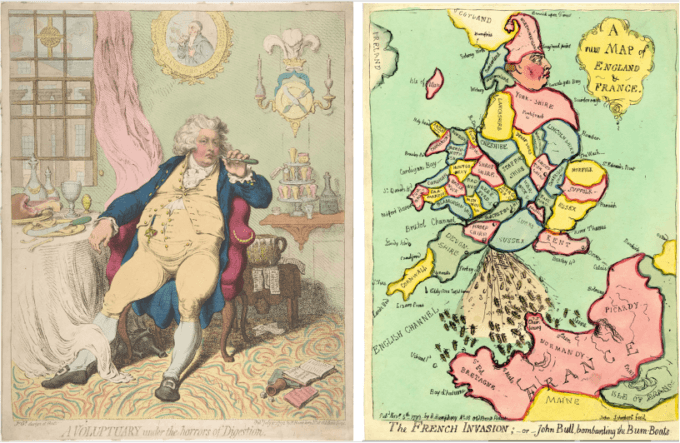
James Gilray, The French Invasion, Nov. 5, 1793; and A Voluptuary under the Horrors of Digestion, July 2, 1972. The British Library.
A few decades after, the French caricaturist Honoré Daumier created an homage to Gilray with a lithograph titled Gargantua, which represents the French King Louis Philippe as the obese and omnivorous hero of Francois Rabelais’ novel of that title. (It was Gargantua and Pantagruel that led Bakhtin to speculate about the existence of an early modern theory and practice of social inversion.) King Louis-Philippe sits on his throne/commode consuming the wealth of the poor and shitting out sinecures and decorations for the rich and powerful.
Daumier in turn, inspired another artist committed to exploring the “material bodily lower stratum.” In 1889, the Belgian James Ensor depicted King Leopold II, along with (from right to left), personifications of catholic education, the church, the bourgeoisie and the army, squatting on the rim of a communal latrine and delivering shit to admirers below. The excrement is consumed with avidity. The four elites hold placards outlining popular demands (which they ignore) for mandatory education, universal suffrage, and personal military service, that is, an end to the system in which the rich could buy their way out of legally required military service. Ensor was an anarchist, suspicious of the good intentions of any government, and committed to empowering the poor, the un-noticed and the vulgar. His humor – derived from Cranach, Gilray and Daumier — is accordingly crude, the better to repel bourgeois art lovers and attract the disaffected.
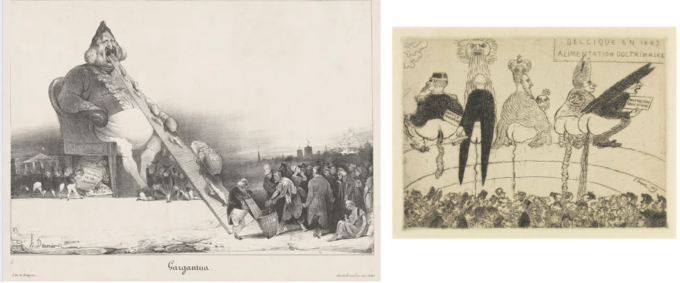
Honore Daumier, Gargantua, 1831. Yale Art Gallery; James Ensor, Doctrinal Nourishment, 1889. Museum of Fine Arts, Ghent
What all these examples of scatological art have in common, and what distinguishes them from Trump’s AI generated video King Trump, is that they embrace the demotic over the sclerotic, the people over the privileged. The Trump meme on the other hand, embraces the “king” (as the title suggests), over his subjects. It stands the carnivalesque tradition upside-down and is thus anti-populist. From public relations standpoint, it’s idiotic. The protesters shown in the meme after all, aren’t visibly different from likely viewers – Republican or Democratic — and most people reject the idea of being shat upon by their elected leaders. The recent electoral drubbing suggests – to say the least — a flawed White House communications strategy.
Trump as Christ and the Virgin Mary
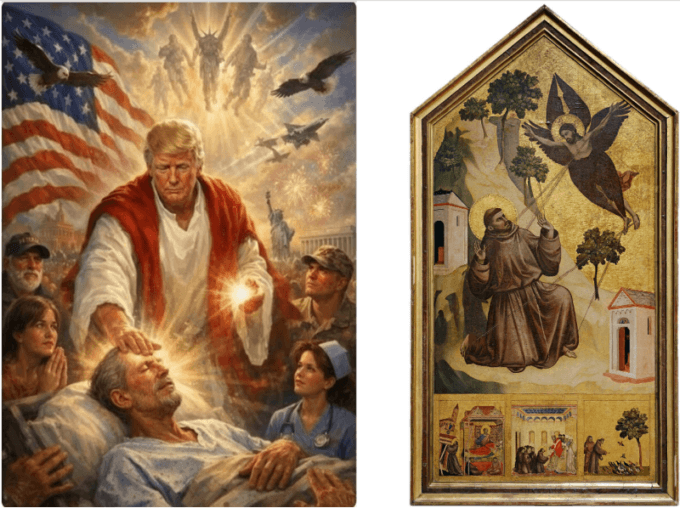
Artist unknown (AI generated), Untitled (Trump as healing Christ). TruthSocial.com@realdonaldtrump, April 12, 2026; Giotto, St. Francis Receiving the Stigmata, c. 1300. Paris, Louvre.
Another meme, discussed briefly in a previous column, shows Trump as a healing Christ. He wears a white toga beneath a red poncho draped over his shoulders. Rays of light emanate from both hands, one of which is pressed against the temple of a recumbent man, a patient. A nurse is represented at lower right, reinforcing the medical ambience.
Figures holding balls of light, like Trump does here, are relatively common in art history. But hands projecting light are rarer. In a panel by Giotto for the Church of St. Francis in Pisa now in the Louvre (c. 1300), Christ projects rays from both hands, though it isn’t so much a light that illuminates as beams that burn, like a laser, imprinting the stigmata on the hands, chest and feet of Francis. The light projection motif is more explicit in the much later Virgin Mary of the Miraculous Medal by A-J-M Vachette, shown here, and on a medal struck around 1830.
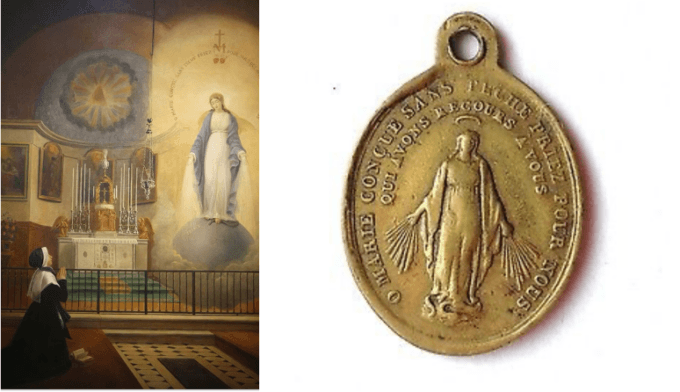
Louis Alexis Le Cerf, Apparition of the Virgin to St. Catherine Labouré, 31st July 1830, Chapel of Our Lady of the Miraculous Medal, Paris; Adrien-Jean-Maximilien Vachette, The Miraculous Medal of the Immaculate Conception, (present whereabouts unknown).
In the first, the Virgin in heaven, crushes a serpent (representative of evil) while standing on a globe – typical iconography of the Immaculata. More unusually, rays of white light fall like a cascade from her hands. The painting was commissioned in response to a reported miracle: A young nun, Catherine Labouré from the order of The Daughters of Charity of St Vincent de Paul on the Rue de Bac in Paris, entered her church one day and had a vision of the Immaculata with light coming from her hands. The mother of God commanded the nun to have commemorative medals struck, one of which I show. (She was evidently an entrepreneurial Madonna.)

Logos for Trump sponsored cryptocurrencies left, U.S. dollar-pegged stablecoin launched by World Liberty Financial (WLFI), and right, a Solana-based meme coin called “OFFICIAL TRUMP ($TRUMP)”
Whoever it was that thought of associating Trump with the Immaculate Virgin Mary must have had quite a sense of humor. Equally so the Miraculous Medal. Trump has in fact promoted two such medals — his Trump stable coin USD1, and crypto-token $TRUMP. Both miraculously made him billions while evaporating the fortunes of thousands of heedless investors. Other motifs in the healing Christ meme seem equally suggestive. Surrounding the sick or dying man are from upper left, a middle-aged man with baseball cap and neatly trimmed white beard and moustache; a youthful, clean-shaven marine; a young nurse – miniscule compared to the gargantuan Trump; and another young woman of no evident occupation, with auburn hair parted in the middle. Here is MAGA personified.
Who devised the pictorial program or iconography of these memes?
Little if any of the iconography of King Trump or Trump as healing Christ, I’d suggest, was specifically requested by the person or persons who prompted the memes. Regardless of the long history of scatological imagery, the first prompt was likely no more than a four-word barnyard phrase: “Trump shits on protesters.” As for the second, I decided to ask AI itself (Gemini) what was the most likely prompt that called it into being. Its answer was the following: “Donald Trump as Jesus healing a patient, in an oil painting style with an American flag and jet fighters in the background.” To my challenge that the image’s iconography was more complicated than that, and there must have been some back and forth between the person who submitted the prompt and AI, Gemini answered with a flat “no”:
“Because the prompt includes the phrases ‘healing a patient’ and ‘Jesus’, the AI draws heavily from its training data, which includes thousands of historical religious paintings. In classical art, a healing miracle is almost never depicted as an isolated event; it is historically framed as a public spectacle witnessed by onlookers. The AI inherently ‘knows’ [the word ‘knows’ in scare quotes] that a miracle scene requires an audience to express awe or devotion.”
“[Gemini continues]: Similarly, adding American and military themes (like the jet fighters and flag) instructs the AI to ground the audience in a specific cultural context. To bridge the gap between ‘religious crowd’ and ‘patriotic military theme,’ the AI automatically populates the onlookers with figures matching that subtext—such as the nurse in scrubs, the veteran in a camouflage hat, and the man in the MAGA cap.” [AI hallucinated the MAGA cap.]
It’s highly likely that none of the iconographical sources I highlighted for either meme were known to the person who originally typed in or spoke the prompts that generated them. Nor were they “known” (scare quotes) by the computer, who after all, “knows” nothing; by the person who presented it to Trump (possibly his know-nothing housing czar Bill Pulte); nor the 80-year-old sociopath-in-chief, who as far as we know, has never once stepped inside an art museum. How then do we go about analyzing meaning in AI slop or what I call crapaganda? Is there any sense to be made of AI stupidity?
Stupidity in theory and practice
Stupidity means the absence of intelligence, but also the refusal – helpless or otherwise — to engage thoughts and ideas. In Jean-Paul Sarte’s biography of Flaubert, The Family Idiot, the philosopher tells us that as a child, the French novelist was considered an idiot because of his retarded language skills. Sartre argues this was the result of being trapped between his parents’ conflicting ideologies, one religious and the other positivist. In response, young Gustave retreated into imbecilic passivity and was incapable of seeing words and sentences as conveyors of meaning. They were instead for him mere blocks of sound or amalgamations of graphemes.
These early struggles with language are what made the mature author hypersensitive to the inertness of cliché, received ideas, and stupidity or bêtise. His goal in writing was to eliminate them. That helps explain his titanic struggles at the writing table: Whole days to complete a page, hours wrestling with a single paragraph or sentence. His final, uncompleted two books, the Dictionary of Received Ideas and Bouvard and Pecuchet were veritable treatises on bêtise.
The second of these, Bouvard and Pecuchet, about two clerks who retire to the country and collect and deploy facts without context or understanding, exemplifies what Sartre called la parole parlée, meaning someone who is passively spoken through language, as opposed to La parole parlante, actively thinking and speaking. At the end of the book, the two men return to their work as clerks, but now they simply copy verbatim all the fact-filled books they had previously consulted and tried to use. Language speaks them. The two men are anticipations of AI, a computer memory that records, transmits and synthesizes everything but understands nothing. An AI chatbot has no morals, scruples, wit, or insight – except when programmed to appear to have them. Language speaks it, not vice versa.
Trump’s bêtise, unlike Flaubert’s, is deployed precisely to nurture psychopathology – “psychoanalysis in reverse” to use Leo Lowenthal’s famous phrase, often cited by Adorno. The purpose of the memes is to induce viewers – informed as well as naïve ones — to accept and embrace cliche and received ideas. To paraphrase Dante: “Surrender thought, ye who enter here.”
The memes discussed here, and the many others released in the first two years of Trump’s second administration, were more than mere stupidities. They were expressions of recklessness and inertia. Like Bouvard and Pecuchet, the U.S. president pursued every hair-brained scheme set out in the books presented to him – or in this case, a single book, Mandate for Leadership: The Conservative Promise (Project 2025), produced by The Heritage Foundation and championed by Russell Vought and Steven Miller. More recently, Trump has drifted aimlessly with malice his only lodestar. In poorer nations, Malaria, HIV, Tuberculosis, Polio and Ebola are on the rise. In the U.S., measles is once again a menace to children and others — inertia kills too.
Trumpian bêtise announced the violence to come: the mass arrest, detention, torture, deportation and in some cases murder of immigrants; the draconian and indeed lethal cuts in Medicaid funding and foreign aid; the wars against Venezuela, Iran and more quietly, against Cuba. Even as he recedes into history, Trump will need to be monitored, and constrained – by Congress, the courts, the streets, and possibly constitutional intervention. Stupidity doesn’t preclude, it exacerbates danger.
Stephen F. Eisenman is emeritus professor at Northwestern University and Honorary Research Fellow at the University of East Anglia. He is the author of a dozen books, the latest of which (with Sue Coe), is titled “The Young Person’s Illustrated Guide to American Fascism,” (OR Books, 2014). He is also co-founder of Anthropocene Alliance. Stephen welcomes comments and replies at s-eisenman@northwestern.edu
Nenhum comentário:
Postar um comentário