
Por Brandon Novick
 |
Photograph Source: Molly Adams – CC BY 2.0 |
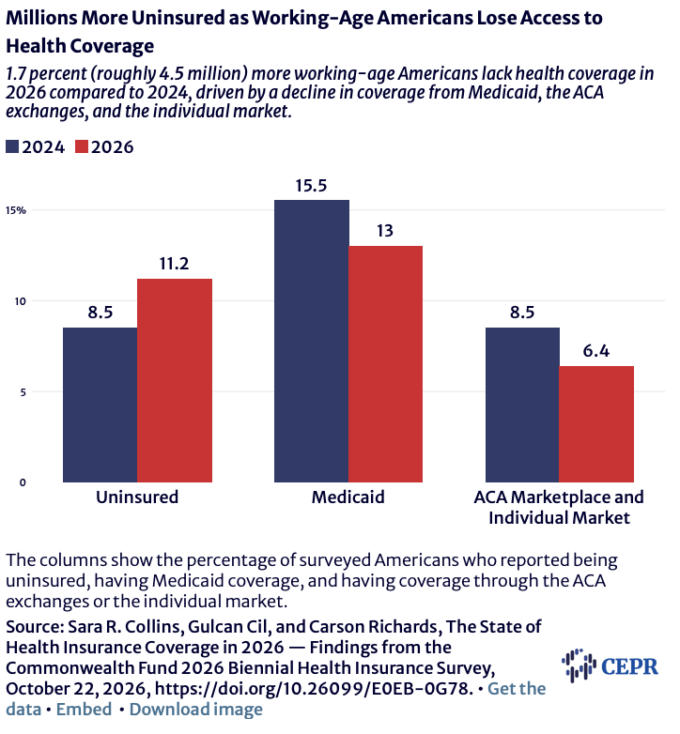
In 2024, around 8.9 percent of Americans of working age — ages 19 through 64 years — reported being uninsured. This increased to 11.2 percent by 2026. This difference roughly translates to over 4.6 million more working-age Americans being uninsured in 2026 than in 2024.
This increase in the uninsured population has been driven by the decline of people getting insurance through Medicaid along with the individual market or Affordable Care Act exchanges. In 2024, 15.5 percent of working-age Americans reported having coverage through Medicaid, and this dropped to 13.0 percent in 2026. In 2024, 8.5 percent reported getting coverage through the individual market and ACA exchanges; this fell to 6.4 percent in 2026.
These changes were expected given that the Trump administration and Republican-led Congress have pushed policies that directly made it harder for people to get coverage through either Medicaid or the ACA exchanges. For the former, Medicaid enrollees have faced greater administrative and bureaucratic hurdles after Congress ended pandemic-era continuous coverage protections in 2023. Additionally, the health policy organization KFF estimated that over 281,000 legal immigrants lost Medicaid coverage this month due to the 2025 One Big Beautiful Bill Act (OBBBA). Disenrollment may also have come in anticipation of more effects of the OBBBA, which cut $911 billion dollars from Medicaid over a decade and instituted work requirements. These requirements will force enrollees to prove every six months that they are working a sufficient number of hours to get access to coverage. While they are not meant to be fully implemented until next year, a few states have already begun implementing changes.
For the latter, Congress refused to extend the enhanced subsidies to help Americans afford the premiums for plans offered on the ACA exchanges, dramatically increasing the costs for individuals and families alike and, thus, making it harder to afford coverage.
Lack of health insurance is not simply a problem for the unemployed or those who are either unable or refuse to work. Working Americans are more likely to not have health insurance compared to the population overall. According to US Census data for 2025, 10.2 percent of all workers were uninsured compared to 7.9 percent of the US population. This even held true for workers who worked full-time, year-round, among which 9.0 percent were uninsured.
Millions of Americans lack health insurance at the same time as health care costs are soaring. According to the Department of Health & Human Services’ (HHS) Medical Expenditure Panel Survey (MEPS), the average spending on health care per person rose 23.4 percent from $6,765 in 2020 to $8,347 in 2024. Median spending rose 22.1 percent from $2,038 to $2,488.
The cost of health insurance for millions of Americans has ballooned during the second Trump administration. The average cost of a benchmark plan on the Affordable Care Act exchanges for a 40-year-old shot up from $5,964 in 2025 to $7,500 in 2026. For workers with employer-sponsored coverage, the average annual cost of premiums for single individuals that is directly deducted from their paychecks rose 16.1 percent from $1,440 in 2025 to $1,672 in 2026. For family coverage, these costs rose 9.1 percent from $6,850 to $7,471. These increases far outpace inflation, which from September 2025 to September 2026 was only 3.74 percent.
The Need for Medicare for All
The fact that millions of Americans lack health insurance — and millions more have inadequate insurance — is entirely avoidable. Through a Medicare for All, single-payer system, the United States can provide comprehensive health coverage to all of its citizens.
The United States is not only able to afford this as the wealthiest country on the planet, but we can save money by doing so. Repeated analyses of Medicare for All consistently show hundreds of billions of dollars in annual savings, including a study conducted by the Mercatus Center which is ideologically opposed to the proposal. The current system is so wasteful with high administrative costs, inefficient with a complicated, massive bureaucracy, and expensive due to predatory health insurance companies that it costs more to cover less people than a universal Medicare for All system.
Medicare for All not only saves money, but it would undoubtedly save lives. Different estimates have projected anywhere from tens of thousands of prevented deaths annually to over one hundred thousand if a Medicare for All system were adopted in the United States. These studies are based on models and, thus, could be overestimates. Regardless, it is logically true and backed by research that when millions of people do not have any health insurance or sufficient coverage to afford their care, many of them get sicker and die.
As I discussed in CEPR’s Majority Agenda of policies that most Americans agree with and which would greatly improve life in the United States, a government guarantee of health coverage is immensely popular. This has only grown more true since then. Gallup found that 64 percent of US adults believed in 2025 that it is the federal government’s responsibility to ensure that all Americans have health care coverage, the highest number since 2007. KFF in 2026 found that 66 percent of US adults supported Medicare for All specifically, a 13 percent increase from 2020 and the largest share that the organization has ever recorded.
As millions of Americans currently lack health insurance, it is imperative to know that this is a completely solvable issue. Medicare for All is widely popular, would save both money and lives, and guarantees all Americans health coverage.
This first ran on CEPR.
Brandon Novick is a Program Outreach Assistant for the Domestic Team at the Center for Economic and Policy Research in Washington, D.C.
Nenhum comentário:
Postar um comentário