
Por Robert Hunziker
 |
Image bya ActionVance. |
The planet has flunked its annual physical exam. Seven of nine planetary boundaries have been breached. This means: “Human activities have pushed Earth beyond its Safe Operating Space. The planet’s natural resilience is weakening: Global warming is accelerating, ecosystems are showing clear signs of degradation, and early warning signs of tipping points are emerging in key systems.” (Johan Rockström, joint director of the Potsdam Institute for Climate Impact Research in Germany Planetary Health Check 2026.)
The Planetary Health Check 2026 (PHC ’26) comprehensive (beautifully done) report is exhausting to contemplate: 124 pages of scientific analysis while not knowing for sure what to do on an individual basis to help what appears to be a train wreck in slow motion. Screaming!!! comes to mind, but then again, who’s listening and do they really care? After all, the planet is so big and so overwhelming; what can one person do? But it’s what people do not do that makes a difference, for example, stop using fossil fuels in favor of solar energy.
Indeed, it’s disturbing that seven of nine planetary boundaries have been transgressed; it’s not a good look and demands attention, assuming something, if anything at all, can be done to help; here are the seven infamous transgressions:
1. Climate Change influenced by greenhouse gas emissions and global temperatures.
2. Loss of Biodiversity
3. Extensive Deforestation and Habitat Conversion
4. Freshwater Change via alteration of river flows, soil moisture, and water usage
5. Biogeochemical Flows via disruption of natural nitrogen and phosphorus cycles because of synthetic fertilizers.
6. Accumulation of man-made pollutants, synthetic chemicals, and plastics.
8. Ocean Acidification via excessive levels of CO2.
Two-of-Nine boundaries remain safe: (8) Stratospheric Ozone Depletion thanks to global bans on ozone-depleting substances (9) Atmospheric Aerosol within safe limits.
“With seven out of nine boundaries transgressed, we have pushed Earth outside of its Safe Operating Space – meaning that we are turning Earth from a safe home into one full of hazards that threaten people across the world… The only way to bring Earth below 1.5°C of global warming is to phase out fossil fuels and, simultaneously, to reverse the transgression of the other Planetary Boundaries – especially by safeguarding the integrity of the biosphere,” Ibid.
Living Beyond Earth’s Limits
It’s only too obvious that “reversing the transgressions of planetary boundaries” is easy to suggest as a solution, but, come on, based upon 200 years of human experience, not happening any time soon, if at all, better to brace for the inevitable.
More to the point, there’s a bigger overwhelming problem at hand: A recent study found today’s population overshoot of 8.3 billion to be far above what can be sustained by a wheezing, coughing planet hobbling on one crutch: “Humanity may already be living far beyond what Earth can sustainably support, according to a sweeping new study analyzing more than 200 years of population and environmental data. Researchers found that while population growth once fueled innovation and expansion, the trend shifted decades ago as the planet’s resources became increasingly strained.” (Humanity Has Already Exceeded Earth’s Limits, Study Warns, ScienceDaily, May 27, 2026)
According to the study, population growth accelerated before the 1950s. More people led to greater innovation, increased energy use, and technological advances that supported more growth, but the pattern changed during the 1960s as population continued to increase. “This shift marked the beginning of what we call ‘a negative demographic phase,’ according to Corey Bradshaw, Matthew Flinders Professor of Global Ecology at Flinders University,” Ibid.
Population growth was only possible because societies relied heavily on fossil fuels and consumed natural resources faster than Earth can replenish them. “The truly sustainable population is much lower and closer to what the world supported in the mid-twentieth century. Our calculations show a sustainable global population closer to about 2.5 billion people if everyone were to live within ecological limits and comfortably, economically secure living standards,” Ibid.
As a result of today’s real world of 8.3B people making demands on the planet, straining/exceeding seven key boundaries, according to Astrophysicist Neil deGrasse Tyson d/d Sept. 28, 2026: “The United Nations Environment Programme has acknowledged that the world has lost the opportunity to prevent certain severe consequences of climate change, marking a shift in the global response strategy. According to a major report released in early September 2026, exceeding the 1.5 degrees Celsius warming threshold set by the Paris Agreement is now unavoidable in the coming years due to accumulated greenhouse gas emissions from fossil fuels. This overshoot means some of the most damaging effects, including (1) accelerated sea level rise (2) irreversible glacier and ice sheet melt (3) intensified extreme weather events (4) ecosystem disruptions, and (5) threats to food and water security, can no longer be fully averted.”
Is the Planet a Socialist?
With 8.3 billion people straining resources, the only conceivable way to tackle seven out-of-bounds planetary boundaries requires global cooperation and equitable ‘Per Capita GDP’ contributions, which is foreign to capitalistic principles of rugged individualistic ownership and profit-oriented competitive free markets, “let the markets decide” cannot ignore a profit motive. Yet, socialism depends upon equitable distribution of resources. How else is it possible to tackle the Great Overshoot?
“Mainstream environmentalists seek to solve ecological problems almost exclusively through three mechanical strategies: (1) technological bullets, (2) extending the market to all aspects of nature, and (3) creating what are intended as mere islands of preservation in a world of almost universal exploitation and destruction of natural habitats. In contrast, a minority of critical human ecologists have come to understand the need to change our fundamental social relations. Some of the best, most concerned ecologists, searching for concrete models of change, have thus come to focus on those states (or regions) that are both ecological and socialist (in the sense of relying to a considerable extent on social planning rather than market forces) in orientation.” (Ecology and the Transition from Capitalism to Socialism, Monthly Review, November 2008)
Altering How the Earth System Works in Only 70 Years
“Human beings have been changing their environments for thousands of years. What we have not had before the past seventy years is change that actually alters the way the Earth System works, an actual break with the conditions that have been dominant on Earth for some twelve thousand years.” (An Ecological Civilization Will Have to Be Socialist, Monthly Review, January 2025)
Profits versus Socialism
“The main driving force of capitalism is to make a profit, to increase the wealth of a small layer of people. That is its whole objective. Many things follow from that. One of them is a society with a short-term view of everything… Only by eliminating the profit motive as the driver of the economy is it going to be possible to stop large-scale destruction of the environment, because ultimately, the way you get richer is by destroying the environment, taking the natural world and converting it into money. That is what socialism aims to change, eliminating the profit motive as the central driver of the economy,” Ibid.
Socialism is More Popular Than Ever in the U.S., According to Polls, Time, d/d September 25, 2026, to wit:
“Forty-three percent (43%) of Americans have a positive view of socialism, the highest share since Gallup began tracking the measure in 2010. The latest survey, conducted Aug. 3-24, found that socialism has gained ground over time as several market-oriented economic concepts have lost favor. It now ranks ahead of big business, which has fallen to a positive rating of 35% from a peak of 58% in 2012.” Boo!
Postscript: This alert from Eliot Jacobson speaks for itself, or as he says: “Everything is not fine.” It’s spooky… real spooky.
Eliot Jacobson
Breaking News!
Code UFB!!!
For the first time in recorded history, the Niño 3.4 sea-surface temperature (SST) is above 30.0°C, reaching a preliminary SST of 30.06°C on October 5th.
The Niño 3.4 SST anomaly is now 3.41°C above the 1991-2020 baseline.
Everything is not fine
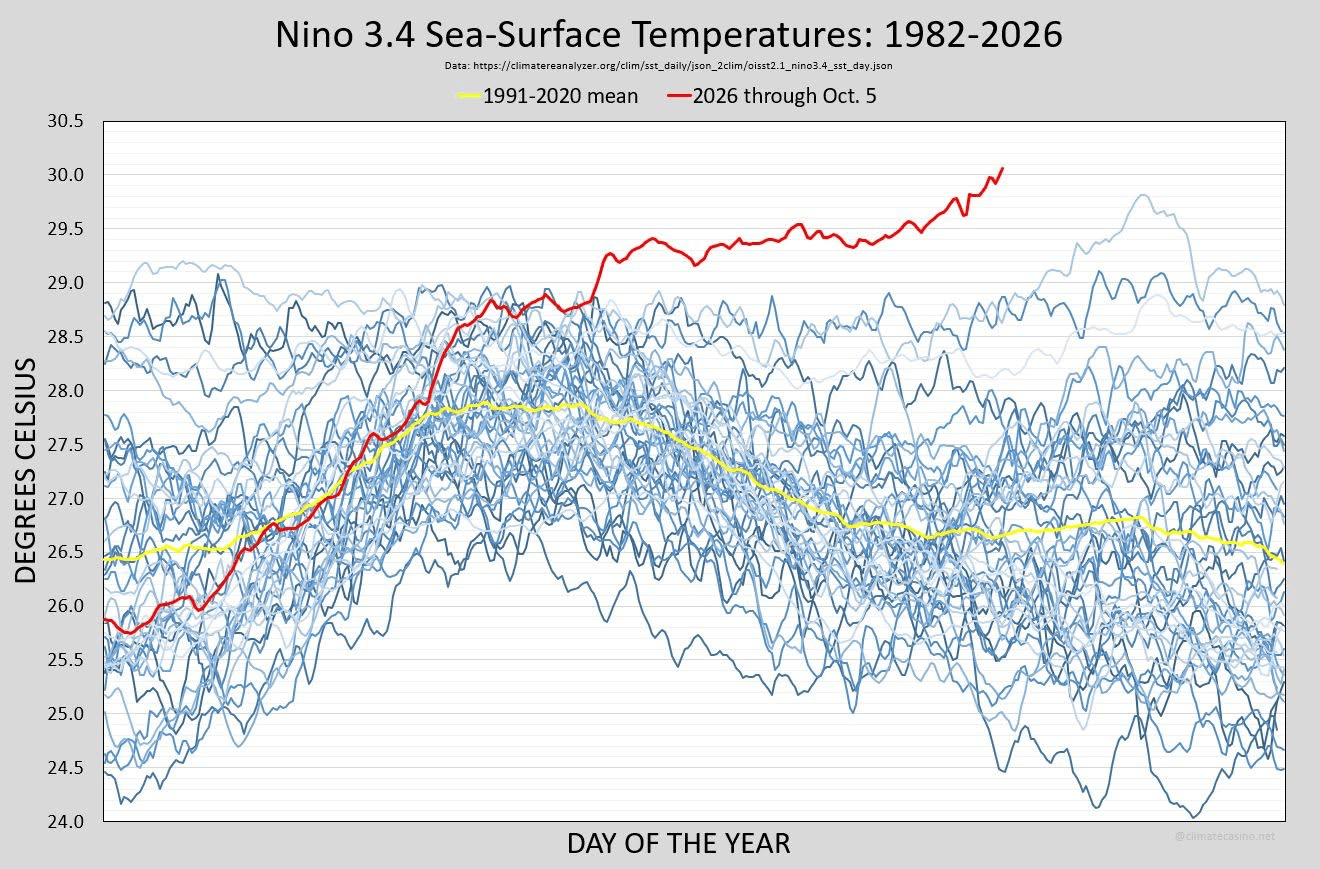
“We’ve never seen an event this big before in the context of our rapidly warming climate … The warning lights are flashing.” (Daniel L. Swain, climate scientist, University of California Agriculture and Natural Resources, d/d October 7, 2026)
Robert Hunziker lives in Los Angeles and can be reached at rlhunziker@gmail.com.
Nenhum comentário:
Postar um comentário