
Por Brandon Novick
 |
Photo by Roberto Sorin |
The Trump administration is colluding with drug companies to blame other countries for high drug prices rather than the undeniable cause: corporate greed and patent monopolies.
Public Citizen recently published redacted versions of the deals the Trump administration struck with Pfizer and Eli Lilly to lower certain drug prices for Americans. However, these deals are incredibly limited and unlikely to affect what most Americans pay for their medicines.
One unredacted provision of the deal with Pfizer provided a notable revelation:
Pfizer agrees to share with HHS … [a] portion of the net increased net revenue that Pfizer realizes from sales of the ex-U.S. version of Covered Products resulting from increased net prices of such ex-U.S. version of Covered Products.
Even though the redactions block the definitions for several key terms, the unredacted text shows that Pfizer has agreed to share increased net revenues from higher prices for drugs already on the market in other countries. In other words, if Pfizer raises the prices of existing drugs in other countries, the US federal government will get a share of any increased net revenue. This arrangement is not permanent, as it ends after January 20, 2029.
Justifying this provision, White House spokesperson Kush Desai said:
President Trump has been very clear that this is not a one-way street: Foreign prices are going to increase and American patients are no longer going to solely bear the burden of funding global innovation … The foreign-revenue provisions are intended to ensure incremental revenue from higher prices abroad benefit American patients, not drugmakers.
This is not the first time the White House has used this rhetoric. The administration has touted its policy of voluntary, individual deals with drug companies by noting that other countries are free-riding off of high American prices. Accordingly, President Trump recently said, “Now, other countries are paying more so that Americans can pay less. We had to get their prices up in order to get our prices down.”
It is absolutely true that other countries pay far less for the same drugs as the United States. But, the idea that foreign prices need to go up to fund lower prices in the United States is predicated on the claim that if other countries enjoy low prices, then drug companies need to charge exorbitant prices to fund research and development (R&D).
To put it simply: that claim is absolutely wrong.
First, if drug companies were so strained in their capacity to fund R&D that they needed to charge exorbitant prices, then it would logically follow that they would not have the money to fund completely unnecessary activities. The problem for the pro-high-prices narrative is that they do.
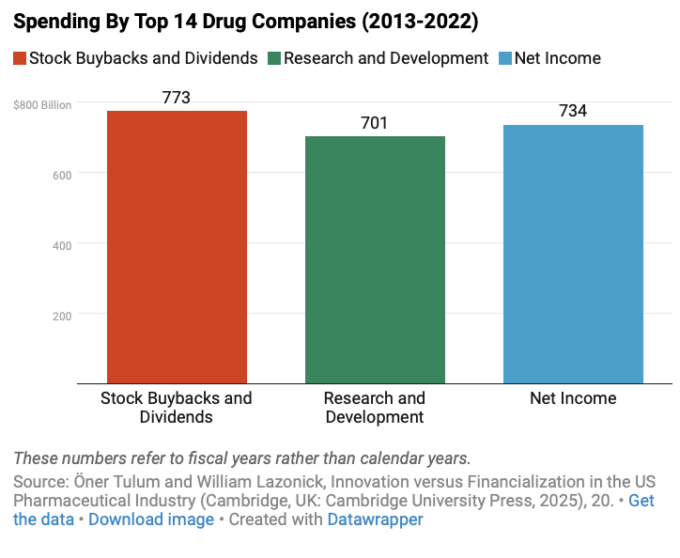
From 2013 to 2022, the top fourteen drug companies spent $773 billion to enrich their shareholders through stock buybacks (a practice that was largely illegal before the Reagan administration) and dividends. This amount is $72 billion more than they spent on R&D and is even more than their net income. Thus, the top drug companies were so flush with cash that they could not just spend more money to enrich their shareholders than on R&D, but they had enough in reserve to feel they could afford to lose money.
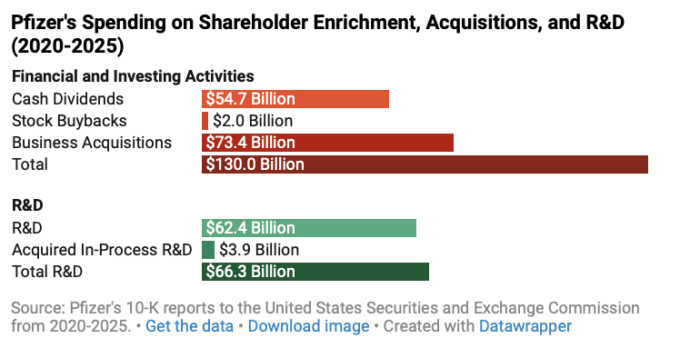
Looking at Pfizer specifically, they had $56.7 billion to spare to enrich shareholders through cash dividends and stock buybacks from 2020-2025. This was 86.0 percent of their $66.0 billion of spending on R&D (including R&D acquired and not started by Pfizer). But, this masks the money Pfizer had to spare. Only $2.0 billion of the $54.7 billion enriching shareholders came from stock buybacks. This is in large part because the company dished out $73.4 billion to acquire other businesses. Putting both shareholder enrichment and business acquisitions together, Pfizer spent over $130.0 billion, twice as much as it spent on R&D.
Second, the reason that drug companies have so much excess cash to enrich their shareholders and acquire other companies – along with billions to lobbygovernment officials and make direct payments to doctors – is that exorbitant prices are not based on R&D costs. They are the result of patent monopolies.
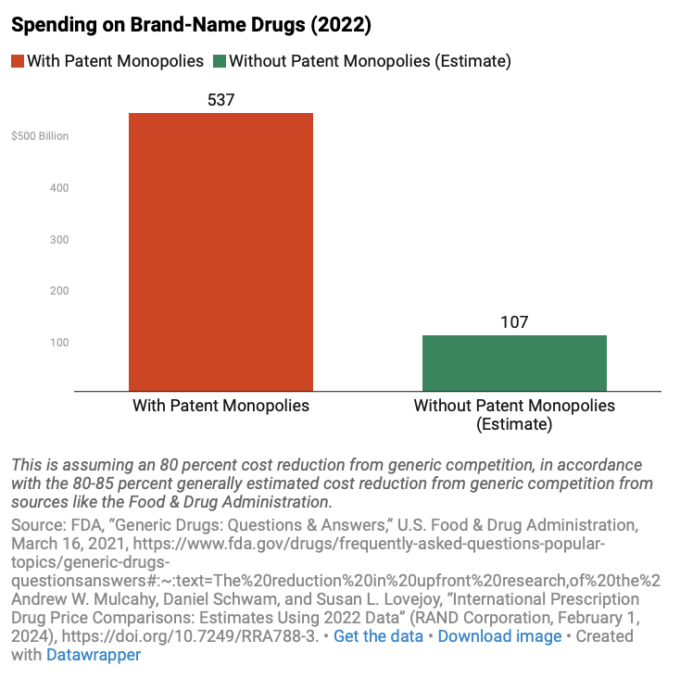
Current federal policy is for the federal government to protect drug companies from competition, thus freeing them to charge three arms and four legs per person. Competition drastically lowers drug prices, as the Food and Drug Administration (FDA) has noted that competition often reduces prices by 80-85 percent. More competition usually produces even lower prices, with one FDA analysis having found that the existence of nine or more generic competitors reduced prices by around 90 percent.
At the same time, patent monopolies exist for a reason: innovators need a financial incentive to invest in R&D. Without such an incentive, innovators would invest massive sums of money to discover new medicines, and free riders could sell competing generic drugs without having made such an investment themselves. Unfortunately for patent monopolies, they are not the only way to give innovators a financial incentive. There are other ways that promote competition and don’t lead to exorbitant prices.
In March of this year, Representative Rashida Tlaib (D-Michigan) introduced the Medicines for the People Act. This bill would use public funds to directly finance R&D in both government labs but also private actors via contracts. This upfront funding would provide the financial incentive so that any resulting drugs would face immediate competition after getting FDA approval. Comparatively, Senator Bernie Sanders (I-Vermont) last introduced the Medical Innovation Prize Fund Act in 2017, which would have an independently-advised prize fund authority award public funds to innovators of new medicines. This model would also result in immediate competition following FDA approval. Both Tlaib’s and Sanders’s models are not mutually exclusive, and they could be the key elements of a system of public financing of medical research.
While public financing is a significant government intervention, the patent system is also a massive form of government involvement. A key difference is that the former fosters the competition that makes capitalism thrive, while the latter leads to government-granted monopolies and incredibly high prices. The savings from competition in the drug market would be enormous. Assuming an 80 percent cost reduction from competition in 2022, Americans would have spent an estimated $430 billion less on brand-name drugs in 2022.
The White House claims that this revenue-sharing arrangement with Pfizer will “benefit American patients, not drugmakers,” but this is the exact opposite of the truth. Instead of dealing with the excessive shareholder enrichment of drug companies or the root cause of high prices — patent monopolies — the administration is encouraging drug companies to raise their prices abroad. Through this, the White House is letting the drug industry off the hook for the exorbitant prices they charge for drugs that further enrich their shareholders and allow them to buy other companies rather than actually increase their investment in lifesaving R&D.
This first appeared on CEPR.
Brandon Novick is a Program Outreach Assistant for the Domestic Team at the Center for Economic and Policy Research in Washington, D.C.
Nenhum comentário:
Postar um comentário