
.jpeg) |
| Por Lynda Williams |
After more than a year of sweeping deregulation at the Nuclear Regulatory Commission (NRC) aimed at paving the way for accelerated deployment of so-called “advanced” reactors, the agency has released one of its most consequential rules yet: a sweeping rewrite of its regulations implementing the National Environmental Policy Act (NEPA), known as Part 51. Released on July 7, 2026, the proposed rule would fundamentally change what environmental impacts the NRC must consider before licensing nuclear facilities.
This sweeping rewrite of the NRC’s NEPA regulations comes in direct response to President Trump’s January 20, 2025, Executive Order 14154, which required every federal agency to rewrite its NEPA regulations after the administration eliminated the government-wide NEPA rules previously issued by the White House’s Council on Environmental Quality (CEQ). Since then, federal agencies including the Departments of Energy, Interior, Agriculture, Defense, Transportation, and the Federal Energy Regulatory Commission have all revised and weakened their NEPA procedures. The NRC’s proposed Part 51 rule is the latest step in that government-wide effort to dismantle longstanding environmental review requirements, following Project 2025’s blueprint for gutting NEPA through streamlined permitting, elimination of cumulative impact analysis, environmental justice, reduced public participation, restricted judicial review, and greater reliance on project applicants to prepare environmental reviews.
The NRC’s proposed rewrite of Part 51 would largely limit environmental review to radiological impacts while excluding most chemical and other non-radiological hazards. The NRC bases this major change on several court decisions that it argues restrict the agency’s authority.
Chemical Hazards Removed
Before NEPA, the Atomic Energy Commission (AEC) argued that its responsibilities were largely limited to radiological hazards. In the landmark case Calvert Cliffs’ Coordinating Committee v. Atomic Energy Commission (1971), the court ruled that NEPA fundamentally changed those responsibilities by requiring the AEC to incorporate environmental values into its licensing decisions. The court held that the AEC was “not only permitted, but compelled, to take environmental values into account.” That decision became the legal foundation for more than fifty years of NRC environmental reviews that considered environmental impacts beyond radiation alone.
The NRC relies heavily on the Supreme Court’s 2025 decision in Seven County Infrastructure Coalition v. Eagle County, where the federal government was approving a railroad in Utah. Environmental groups argued that the Environmental Impact Statement should also analyze future oil drilling, oil refining, and other industrial activities that might occur because the railroad would transport crude oil. The Supreme Court ruled that those separate “upstream” and “downstream” projects did not have to be analyzed as part of the railroad approval.
The NRC argues that the same reasoning allows it to exclude non-radiological chemical hazards from its own NEPA reviews, even when those chemicals are part of the very project the NRC is reviewing. That omission could be challenged under the Administrative Procedure Act, which requires federal agencies to provide a reasoned explanation when they make major changes to longstanding policy.
Oklo, an advanced nuclear company backed by Sam Altman and Peter Thiel, recently received a share of a $19 million Department of Energy award for advanced fuel reprocessing, or “recycling.” Oklo wants to commercialize spent-fuel reprocessing in the United States using pyroprocessing, a chemical process that separates reusable uranium and plutonium from highly radioactive spent nuclear fuel through electrorefining in molten salts using cadmium, a known human carcinogen. Using cadmium is not some separate upstream or downstream project; it is an essential ingredient of the pyroprocessing facility the NRC would be licensing. Under the proposed Part 51 rule, the NRC argues that it would no longer have to analyze the environmental risks associated with cadmium simply because they are considered non-radiological.
Another example is Valar Atomics, a nuclear startup company backed by Anduril founder Palmer Luckey and Palantir CTO Shyam Sankar. Valar was selected under the DOE’s Fuel Line Pilot Program, which authorizes it to build and operate its own TRISO fuel fabrication facility without an NRC license during the non-commercial phase. Valar’s fabrication process relies on hazardous industrial chemicals, including nitric acid to dissolve the uranium and ammonia to form the fuel kernels, along with reactive gases used to apply the ceramic coatings. Under the current rule, the storage, handling, emissions, and exposure risks of these non-radiological chemicals could be pulled into the environmental analysis for such a facility. Under the new rule, they would be exempt—only the radiological content of the uranium would fall within the NRC’s required review, leaving the chemical hazards of the fabrication process unexamined.
The Paducah Gaseous Diffusion Plant in Kentucky, where decades of chemical processing left behind a groundwater plume of trichloroethylene and other contaminants still being cleaned up today. (Photo: U.S. DOE)
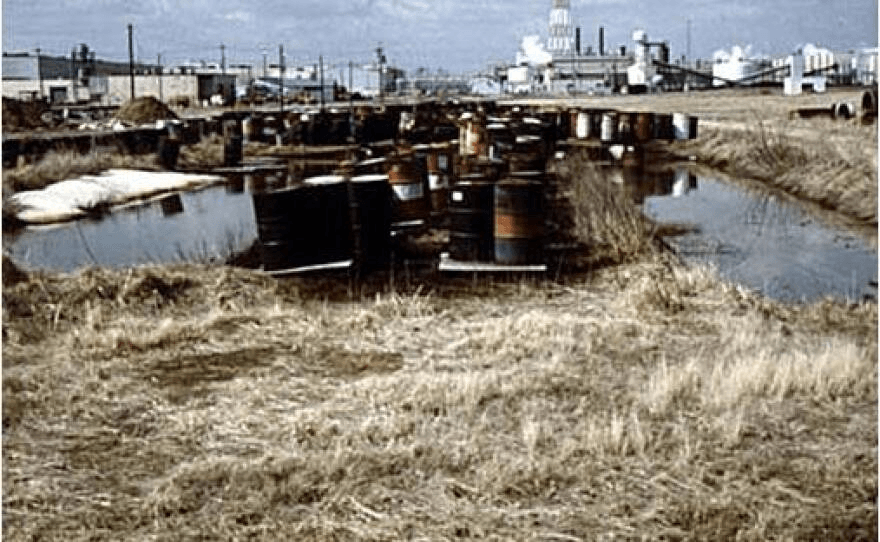
History shows why chemicals matter in nuclear projects across the fuel cycle. Some of America’s worst nuclear environmental disasters were driven not by radiation alone, but by industrial chemicals used throughout the nuclear fuel cycle. The Paducah Gaseous Diffusion Plant and Portsmouth Gaseous Diffusion Plant are contaminated by massive groundwater plumes of trichloroethylene (TCE), along with PCBs, solvents, and other hazardous chemicals. The Hanford Site—one of the most contaminated places on Earth—faces cleanup not only from radioactive waste but also from enormous quantities of carbon tetrachloride, chromium, nitrates, heavy metals, solvents, and other industrial contaminants.
Cumulative Impacts Omitted
Just as telling as the changes the NRC proposes is what it leaves out: cumulative impact analysis. Traditionally, one of NEPA’s central purposes has been to ensure that agencies evaluate not only the impacts of an individual project, but also the combined effects of that project together with other past, present, and reasonably foreseeable future actions. A project that appears insignificant in isolation may have significant environmental consequences when those impacts are added together. The proposed Part 51 rule no longer requires cumulative impact analysis as part of either an Environmental Assessment or an Environmental Impact Study.
The omission becomes even more significant when combined with the NRC’s proposed Part 57 licensing framework for “advanced” nuclear reactors. Part 57 would allow companies to deploy multiple identical reactors at the same site—or even across multiple sites—under a single construction permit and a single safety review of the reactor design rather than starting from scratch for every reactor. Part 57 governs how reactors are licensed; Part 51 governs what environmental impacts the NRC must analyze. Together, they determine what questions a large-scale reactor buildout actually has to answer.
Aalo Atomics is another advanced nuclear startup backed by Valor Equity Partners, whose investments include xAI and AI infrastructure. The company was selected by the Department of Energy to test its Aalo-X reactor at Idaho National Laboratory and is developing the Aalo Pod specifically to power AI data centers. Rather than deploying a single reactor, each Pod consists of five identical 10-megawatt sodium-cooled modular reactors connected to a single steam generator to produce 50 megawatts of electricity. The company has also stated that the design is intended to scale to even larger multi-reactor installations. Under Part 57, those reactors could be licensed under a single construction permit based on one reactor design. Yet under the proposed Part 51 rule, there is no requirement for the NRC to evaluate the cumulative environmental impacts of all five reactors operating together at one site—not the combined water use, the combined radiological source term, the combined waste inventory, the combined chemical inventories, or the total burden placed on the surrounding community.

A rendering of Aalo Atomics’ proposed “Aalo Pod” — five 10-megawatt sodium-cooled reactors sharing a single steam generator, designed to power AI data centers.
For decades, cumulative impact analysis has been one of the principal legal tools used by environmental organizations, Tribes, and local communities to challenge inadequate environmental reviews. Courts have repeatedly required agencies to consider the combined effects of related actions rather than evaluating projects one piece at a time. Removing cumulative impact analysis from Part 51 therefore does more than shorten environmental reviews—it eliminates one of the most important legal safeguards that has held agencies accountable under NEPA.
NEPA trumps Trump
Eliminating cumulative impact review and narrowing “effects” to radiation alone rests on shaky legal ground. The NRC’s attempt to gut environmental protections and public oversight of new nuclear projects on the strength of President Trump’s executive orders is a regulatory overreach and an abuse of its power. NEPA is law: before a federal agency approves a project, it must examine the environmental consequences from every aspect of the project itself. NEPA Law trumps Trump’s executive orders.
Submit your comments now. Your voice matters. Docket NRC–2025–0478
Comment deadline: August 21, 2026: https://www.regulations.gov/docket/NRC-2025-0478
Lynda Williams is a physicist and environmental activist living in Hawaii. She can be found at scientainment.com and on Bluesky @lyndalovon.bksy.social
Nenhum comentário:
Postar um comentário