
Por Joshua Frank
 |
Colby Groves, documenting Amazon’s Baldy Mesa solar project.
This week in the Anthropocene
The road is dusty and trash-strewn. My friend and collaborator Colby Groves is hanging out the car window as I drive, gazing at a patchwork of solar panels lined up behind a chain-link fence.
“This has to be it,” declares Colby, balancing a large camera on his lap, hoping it doesn’t bounce off as we traverse a series of bumps and divots.
We are in this land of scorching sun and heat, searching for a large Amazon solar installation in rural San Bernardino County, California. This is the home of the endangered desert tortoise and Joshua trees, but more recently, it’s become a plaything for greedy Silicon Valley entrepreneurs.
In 2014, Jeff Bezos’ Amazon connected its Baldy Mesa solar-and-storage project, which helps to power the company’s nearby data centers, to the electrical grid, earning accolades for its use of renewable energy. It’s the first of its kind in California. Despite its gargantuan size, the project faced very little opposition, as is often the case with such “green” projects.
 |
As we step out of the car, we immediately hear the loud hum of a football-field’s worth of batteries, powered by solar panels that surround us in every direction. The entire setup is connected to the grid by towering transmission lines. Altogether, this sprawling array covers 1,500 acres of Mojave Desert habitat, almost twice the size of New York City’s Central Park.
Baldy Mesa’s impact on this delicate ecology is stark and tangible. Where Joshua trees once stood, Lego-like blocks of batteries the size of shipping containers now buzz and radiate heat. Where coyotes once scampered and desert tortoises burrowed, solar panels now blanket the landscape. Amazon avoided controversy by relocating 153 doomed Joshua trees, but the fact remains, there’s not a single Joshua tree where these photovoltaic panels now sit.
This particular Amazon Web Services (AWS) facility is an AI-driven machine-learning operation capable of analyzing 33 billion data points each year. That’s over 90 million data points a day. They claim it will allow their batteries to run more efficiently, while making you a better, wiser consumer of Amazon’s products and services.
As far as corporate marketing gimmicks go, this sure sounds nice. Yet, as I stand in the middle of Amazon’s solar farm, I can’t help but wonder what this desert must have been like before they decided it was better suited to powering AI programs. What was it like out here when the soil could still sequester carbon? Building on these lands has eliminated its ability to absorb fossil-fuel pollution. These solar panels are actually hurting the climate, not helping it out.
Even though this behemoth runs on renewable energy, nothing about it feels eco-friendly. Like so much of this AI-driven madness, there is a very post-apocalyptic aura to it all, made worse by the fact that Jeff Bezos is reaping the spoils.
“Wow, look at that.” Colby points to a fence set up to protect the battery installation. The gate is wide open.
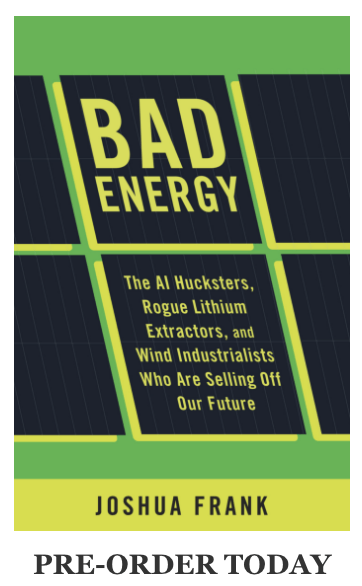
Someone more inclined to commit sabotage would have no difficulty gaining access. But we aren’t here for data center mischief. Colby sets up his tripod to shoot footage to accompany Bad Energy, my forthcoming book exploring the downside of the so-called green energy transition.
Few people will ever make their way to this remote spot in the Mojave to witness firsthand what Amazon has wrought. Aerial photographs obscure the reality of what it’s like on the ground amid the AI upheaval being thrust upon us without our consent.
And, despite my many misgivings, this whole monstrosity is allegedly one of the better ones. Most new data centers aren’t powered by renewables but by fossil fuels.
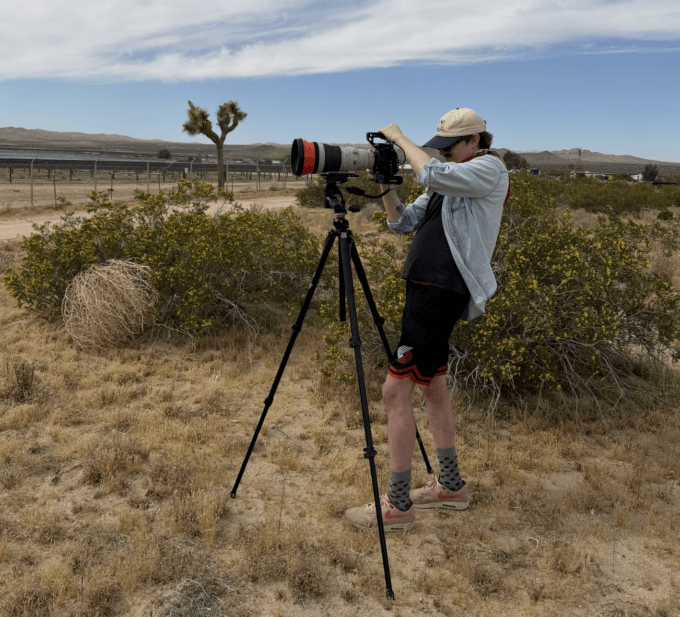 |
Colby Groves in action.
+++
Unless you’ve been slithering under a rock for the last few years (I empathize with you!), you know data centers are bad news.
They suck up water. 17.4 billion gallons annually in the US.
They burn electricity. 176 terawatt-hours (4% of all US energy use) yearly. Globally, they use 415 terawatt-hours, which is more than that of only 10 countries.
They are creating heat islands. In some cases, warming the land around them by 16 degrees Fahrenheit.
They eat up land. The average data center is the equivalent of 450 football fields.
They aren’t long-term job producers. Even the Wall Street Journal calls data centers a “job-creation bust.”
And of course, they are the beating heart of the AI revolution, which is encroaching on every aspect of our lives.
But really, how bad are these damn things? After all, they aren’t a new invention; they’ve been around since the dawn of the computer age.
Yet, something is quantitatively different about what’s happening. At the current pace, data centers globally will require $1 trillion in annual infrastructure investment by the end of the decade.
It helps to put all of this in numbers.
In the United States, there are between 1,500 and 1,600 data centers in the planning or construction phase, with over 4,000 already operating. A Pew study estimates that 67% of these new plants are coming to rural America, where 87% of existing centers currently operate in urban zones.
There are 754 data centers planned in the South. 277 in the West. 419 in the Midwest and 106 in the Northeast. Right now, Pew has shown 38% of Americans live within 5 miles of a data center.
Globally, there are 11,000+ data centers, and economies of scale are expected to dominate. This means the footprint of future data centers will matter more than the number of data centers being built. The energy required for this growth, as the Southern Environmental Law Center predicts, will supercharge climate chaos.
This is because many of these new plants use natural gas to generate power. Natural gas, while not as dirty as coal, releases methane, which, in the short term, is even more harmful than carbon dioxide. Gas plants also emit carbon. Lots of it. A study released in April predicted that just three of Microsoft’s AI-powered, methane-gas-powered data center projects will double the company’s carbon footprint and spew large amounts of pollution.
Another paper from researchers at Cornell predicts that up to 44 million metric tons of CO2 will be emitted by decade’s end if operators continue to rely on natural gas to power their data centers. As Grist reports, that’s like adding 10 million new vehicles on the road. The UN just published a study stating that by 2030, data centers will account for 3% of the world’s total energy use, a total of 935 terawatt-hours of electricity, emitting 440 million tons of carbon dioxide
This week, Columbia Riverkeeper (a fantastic org that deserves your support) dropped a startling report on what planned data centers will do in their corner of the Pacific Northwest. The study exposes how fossil fuel companies, utilities, and Big Tech are colluding to use the surge in data center development to expand gas-fired power plants and more pipelines.
“After years of progress toward achieving our region’s climate goals, we’re suddenly a potential new market for the fossil fuel industry,” says my friend Audrey Leonard, a staff attorney for Columbia Riverkeeper. “Cloaked under a shroud of secrecy, Big Tech opened the window, and now the gas industry is poised to seize an opportunity to build.”
This is a microcosm of what is happening nationwide. Data centers, fueled by massive capital investments in AI, will make it even harder to reduce the country’s contribution to climate chaos.
Then there’s the issue of water.
A crowdsourced map compiled by Erin Brockovich shows that many data centers in the United States are operating in areas experiencing extreme drought. This isn’t good news where water conservation is needed, which may soon be much of the country. As mentioned above, data centers in the US, by one estimate, directly consumed 17.4 billion gallons of water per year. As more of these centers get built, that amount is expected to grow to 38-73 billion gallons annually.
That’s a lot of water, more than the cities of Seattle or San Francisco use in an entire year.
+++
In this week’s good news, I’ll leave you with these little nuggets.
As Jared Kushner, Trump’s right-hand man in the Middle East, moves forward with a $1.6 billion luxury resort in Albania, thousands have taken to the streets to protest, arguing that the development will destroy vital wetland habitats. The pressure appears to be paying off, and a corruption probe has been initiated.
Wild elephants have returned to eastern Zambia for the first time in 50 years, and locals are learning to coexist. And an endangered condor flew in Oregon for the first time in over 120 years.
Pack that in, and I’ll see you next week.
 |
Colby Groves and Joshua Frank in JTNP, photo by Chelsea Mosher.
JOSHUA FRANK is co-editor of CounterPunch and co-host of CounterPunch Radio. He is the author of Atomic Days: The Untold Story of the Most Toxic Place in America, and the forthcoming, Bad Energy: The AI Hucksters, Rogue Lithium Extractors, and Wind Industrialists Who are Selling Off Our Future, both with Haymarket Books. He can be reached at joshua@counterpunch.org. You can troll him on Bluesky @joshuafrank.bsky.social
Nenhum comentário:
Postar um comentário