
Por M.V. Ramana
 |
| Image by Planet Volumes. |
What do Canada’s retired general Wayne Eyre and Saudi Prince Mohammed Bin Salman share in common? Answer: In their own ways, both have inadvertently warned the public about the deep relationship between nuclear weapons and nuclear energy.
The former’s warning came earlier this month, when the retired general told a conference in Ottawa that when it came to acquiring nuclear weapons, Canada should keep its “options open”, pointing out that Canada had “a good nuclear enterprise” including “the civilian infrastructure” and “the scientists”. Eyre, who served as Canada’s chief of the Defence Staff from 2021 to 2024, argued, “Let’s just have the conditions in place so that if we decide to go that way, we can do it in shorter order than some other countries who have no nuclear enterprise. It’s all about hedging”. Part of the strategy he recommended was to invest in aerospace and missile technology.
 |
Canadian government officials were quick to state that the country remained opposed to acquiring nuclear weapons, and others pointed out that such acquisition wouldn’t be so simple. But Eyre was pointing to a deep truth—Canada’s nuclear energy program would facilitate the building of nuclear weapons, should the country decide to do so. Indeed, the Globe and Mail, Canada’s leading newspaper, highlighted this fact in its editorial (“The strong civilian nuclear industry could provide a springboard if ever Ottawa chose to go that way”) even as it argued against Canada building nuclear weapons.
This fact is equally applicable to all countries that acquire the technology to generate nuclear power: they would be closer to having the capacity to make nuclear weapons than if they had not built nuclear plants.
The last time this connection was so prominently broadcast was back in March 2018, when Saudi Prince Mohammed bin Salman told CBS News about Saudi Arabia’s equivalent hedging strategy. Earlier, the country had announced that it was interested in deploying nuclear power plants for “peaceful purposes,” but during the interview, MBS pointed to the possibility that Iran might develop a nuclear bomb, and declared that Saudi Arabia “will follow suit as soon as possible”.
Effacement Efforts
Why are these statements significant? Because there is a long track record of attempts by the nuclear industry and advocates for nuclear power to erase or at least camouflage the connection between the technologies used to develop nuclear energy and the capacity to build nuclear weapons. An early example of the attempt to make the two pursuits seem unrelated was President Dwight Eisenhower’s Atoms for Peace program, which the President announced at the United Nations General Assembly in December 1953 with the stated aim of hastening “the day when fear of the atom will begin to disappear from the minds of the people and the governments of the East and West.”
The Atoms for Peace speech came just seven years after the 1946 Report on the International Control of Atomic Energy that explicitly warned that “the development of atomic energy for peaceful purposes and the development of atomic energy for bombs are in much of their course interchangeable and interdependent.” The intervening years witnessed a dramatic shift in the policy of the United States to build a larger and more destructive nuclear arsenal, including hydrogen bombs, and, simultaneously, a growing movement for nuclear disarmament and peace. The US government was also involved in an effort to induce private companies to build nuclear plants, in part to advance military capabilities. Eisenhower’s speech is an attempt to paper over the contradiction between a claimed interest in peace while developing nuclear capabilities.
In subsequent decades, the nuclear industry and its supporters have resorted to simply denying any connection between nuclear power and weapons. For example, Ted Nordhaus, who recently praised Trump’s nuclear energy in the Washington Post, exhorted people to “stop confusing nuclear weapons with nuclear power.”
Overlaps
There are five overlaps between nuclear energy and nuclear weapons: technical, historical, geographical, personnel and institutional.
Let us start with the technical. The greatest challenge to developing a nuclear arsenal is obtaining the necessary fissile materials, namely highly enriched uranium or plutonium. These materials are “the key ingredients in nuclear weapons.” Neither is found in nature.
Uranium occurs naturally in two main varieties, called isotopes, the heavier uranium-238 and the lighter uranium-235.The latter is the one that can sustain a chain reaction, which is the basis of both nuclear power plants and nuclear bombs. But the concentration of uranium-235 in nature is usually too low for such a chain reaction to occur. Whether it is to make nuclear weapons or to use as nuclear fuel in most common nuclear power plants, the uranium-235 concentration must be “enriched”, from 0.7 percent to 3 to 5 percent for most nuclear power plants and ideally around 90 percent for nuclear weapons. One technical overlap between the processes used to produce nuclear weapons and generate energy is that the facilities used to produce low-enriched uranium fueling nuclear power plants can be modified to produce weapons-useable highly enriched uranium, a technical detail that is at the heart of the dispute over Iran’s nuclear program.
Plutonium, too, is not found in nature but is produced when uranium fuel is irradiated in a nuclear reactor. In order for this plutonium to be used either as nuclear reactor fuel or in nuclear weapons, it must first be separated from uranium and other chemicals in the irradiated fuel through a chemical process called reprocessing.
Historically, many countries built their first nuclear reactors to produce plutonium for use in nuclear weapons. The United States, for example, built reactors in Hanford to produce plutonium, and the first uses for the plutonium thus produced were the nuclear weapon tested in New Mexico in July 1945 and the bomb dropped over Nagasaki.
There are some countries, such as Israel, that only operate nuclear reactors to produce plutonium for nuclear weapons. That is rare. Which points to the geographical connection between nuclear weapons and energy: a significant overlap between the countries that have built nuclear power plants and those that have nuclear weapons. If one looks at the 413 nuclear reactors listed as operational by the International Atomic Energy Agency as of February 2026, 279 of them are in countries with nuclear weapons. If one adds countries that are part of military alliances with nuclear-weapon states, such as members of the NATO alliance, then the overlap is overwhelming.
There is also an overlap in the training needed to have personnel who can design and operate nuclear power plants and who can produce fissile material for nuclear weapons. Examples include Pakistan and Iran, both of which received training for scientists and engineers from the United States.
Munir Ahmed Khan, who was responsible for launching Pakistan’s nuclear weapons program, explained it thus:
“The Pakistani higher education system is so poor, I have no place from which to draw talented scientists and engineers to work in our nuclear establishment. We don’t have [a] training system for the kind of cadre we need. But, if we can get France or somebody else to come and create a broad nuclear infrastructure, and build these plants and these laboratories, I will train hundreds of my people in ways that otherwise they would never be able to be trained. And with that training, and with the blueprints and the other things that we’d get along the way, then we could set up separate plants that would not be under safeguards, that would not be built with direct foreign assistance, but I would now have the people who could do that. If I don’t get the cooperation, I can’t train the people to run a weapons program”.
Finally, there is a deep connection between institutions that oversee nuclear energy and weapons programs, as exemplified in the United States by the Department of Energy (DOE). The National Nuclear Security Administration (NNSA) is a semi-autonomous agency within DOE that is responsible for maintaining the stockpile of nuclear weapons in the United States and for “modernizing” it (namely, to make new weapons). The DOE also promotes nuclear energy through multiple funding mechanisms. There is also a significant overlap between the private corporations involved in building nuclear power plants and servicing the nuclear weapons industry.
Significance
Understanding these connections between nuclear weapons and nuclear energy helps explain why governments around the world continue to support nuclear power despite the multiple problems associated with nuclear power. On top of huge amounts of funding, ultimately from the public, that is made available to nuclear enterprises, the linkage with nuclear weapons is also used to control information flows and exclude outsiders from policy discussions, thus weakening democracy.
The expansion of nuclear energy also thwarts efforts toward a world free of nuclear weapons. It will not be possible to eliminate nuclear weapons without policies and resource-allocation decisions that are grounded in the reality that nuclear energy cannot be separated from nuclear weapons.
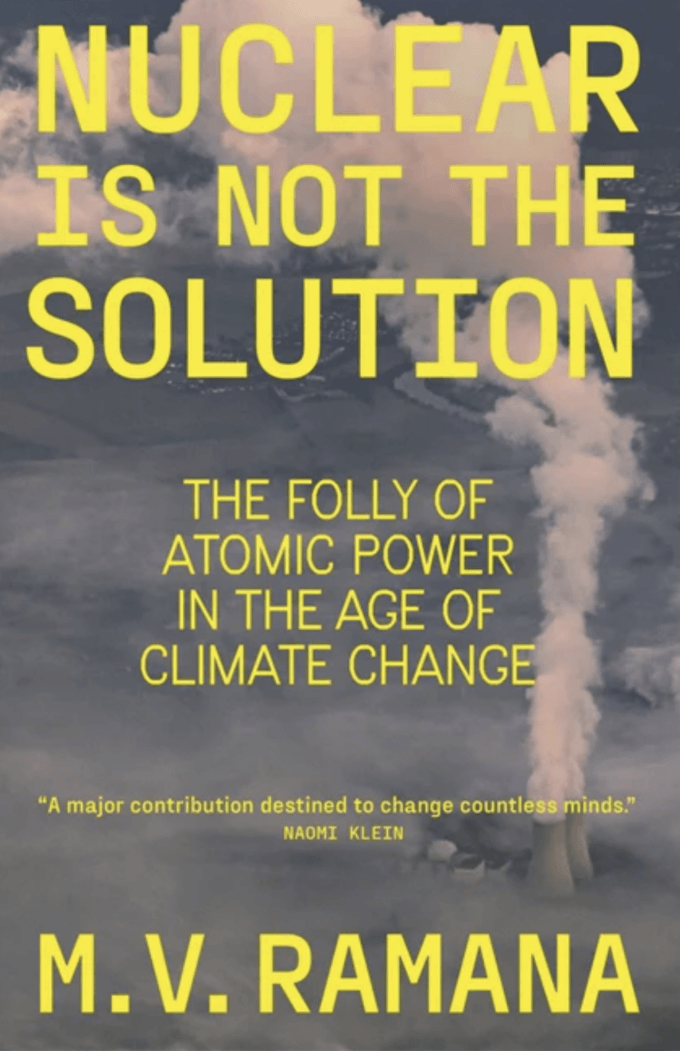
M. V. Ramana is the Simons Chair in Disarmament, Global and Human Security at the School of Public Policy and Global Affairs, University of British Columbia and the author of The Power of Promise: Examining Nuclear Energy in India.
Nenhum comentário:
Postar um comentário