
Por Raouf Halaby
 |
Photograph Source: Rob Pierson – CC BY 2.0 |
It is because you are Palestinian.” That was the rationale used by organizers of a major Christian mission conference in Ireland to explain why they were considering withdrawing their invitation for me to speak at their conference. Their concern was not due to any controversial things I had said or done. …Their hesitancy for me to participate in the conference simply had to do with who I am and where I come from. I was at fault because I am Palestinian.
–Munther Isaac, introduction to The Other Side of the Wall
On October 9, 2026, I led a book discussion on the campus where I had taught for 42 years. To launch the discussion, segments of what follows were read, along with a PowerPoint presentation of art and graffiti exhibited on Israel’s wall of apartheid.
Some 15 years back, an academic administrator told me (in writing and in person) the following: “You say controversial things.” If advocating for and writing for state, national, and international publications about human rights, injustice, dispossession, Palestine, and the tragic plight of her destitute children is controversial, then I wear this charge as a badge of honor.
Now in its 80th year, the Palestine/Israel conflict is the longest and most controversial U.S. foreign policy blunder.
In 1997, Nelson Mandela called the dispossession of Palestinians the most moral issue of his time. “We know too well that our freedom is incomplete without the freedom of the Palestinians,” said Mandela.
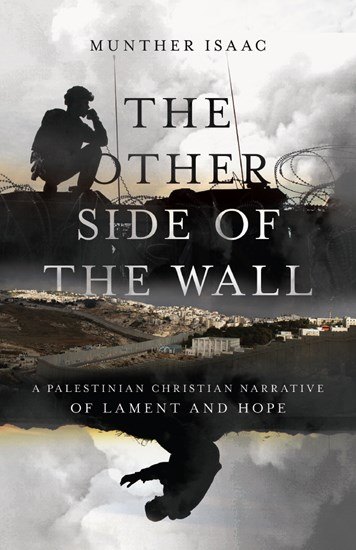
To honor his memory, Palestinian artists have painted scores of Mandela portraits on the same wall of Apartheid around which Munther Isaac, the author of the acclaimed The Other Side of the Wall, builds his personal narrative and his experiences as a Lutheran priest and university dean living under oppressive Israeli occupation.
On the Palestinian side of the Israeli-built wall of Apartheid, the 25-foot-high concrete slabs have become canvases documenting Israeli brutality and apartheid, hence becoming the largest and longest open-air museum in the world. The painfully telling images are a cri de coeur begging an apathetic world to unshackle the manacles of oppression and injustice.
In many ways Munther Isaac and I share similar life experiences. 31 years my junior, Munther was born in Beit Sahour, Palestine, the locale where, according to Mathew’s account of Jesus’ birth, some 2,000 years ago an angel and “a multitude of the Heavenly host” appeared to the shepherds. Today, the illegal Israeli Yatziv settlement is encroaching on Beit Sahour, fragmenting families, farmlands, schools, medical sites, and the community.
With tacit support from the likes of Trump, Stephen Miller and Mike Huckabee, the Netanyahu government, akin to a ravenous anaconda, has been peristaltically gobbling up what’s left of Palestine.
I was born in Jerusalem, Palestine; my family lived at #9 Reuven Street some eight miles west of Beit Sahour, and barely a block off the historic Jerusalem/Bethlehem Road.
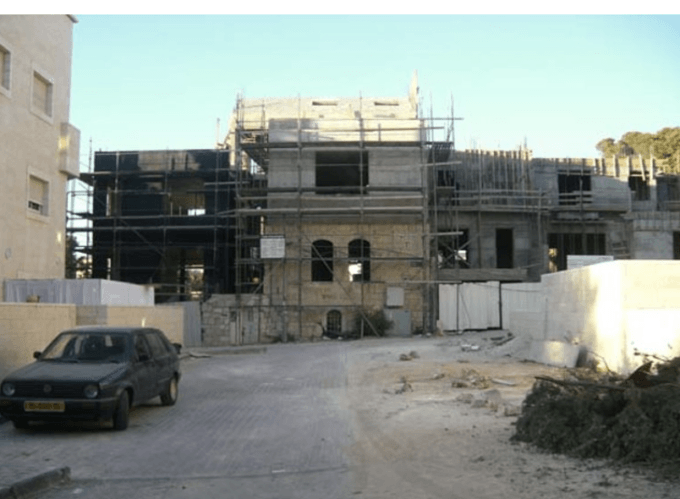
Tanas Halaby house in Upper Bakaa, built around turn of last century.
This is an image of my grandfather’s house, one of the first houses built in Upper Bakka, a burgeoning southwestern Jerusalem Palestinian suburb within walking distance of Jerusalem. Recognizing the value of the unique historic features of this Palestinian architectural gem, its new Israeli owners have decided to preserve its facade and add a third story. And in a sense, my grandfather’s house is a testimonial metaphor writ large for history books. No matter how hard Israel and its many Christian Zionist apologists and sympathizers around the world, and especially the U.S., attempt to wipe Palestine and Palestinians off the map, like my grandfather’s house, the inner core of Israel is Palestinian, and will always remain so.
Munther holds an Oxford PhD; he is a theologian and is Pastor of the Lutheran Christian Church in Bethlehem, Palestine; he is the academic dean of Bethlehem Bible College; he directs the Christ at the Check Point conferences.
Munther and I also share the following: we are Palestinian Christian Arabs; we were both raised in the Orthodox church; our family cars were confiscated by Israeli authorities; we experienced humiliation, legislated racism, apartheid, and dispossession by the Israel government; the academy is an integral part of our lives; we are both considered demographic threats to Israel; advocating for Palestinian statehood and human rights is embedded in our DNA; we’re likely to be accused of being terrorists or terrorist sympathizers; we both have two sons. Because of his leadership in the Christ at the Check Point conferences, Israel has barred him from entering Jerusalem.
Even though my wife and I were part of a fifteen-member fact-finding delegation (American Coalition for Middle East Dialogue – all U.S. citizens), upon entering Palestine in 1988 (through the Allenby Bridge crossing) and due to my Palestinian descent, I was ushered into a 6×7 ft cubicle and strip-searched by an Israeli officer. When finished, the officer took a can of sanitizer off the shelf, sprayed his hands, pulled out paper towels from a dispenser, wiped his hands dry, wadded the damp towels, and threw them in a waste basket. Because Palestinians don’t exist, there was no eye contact whatsoever. This experience triggered childhood memories of life under Israeli occupation. 27 years after leaving my native Palestine, the haunting phrase Aravi Meluhlah (parasitic Arab), a xenophobic epithet barked by Israeli officials at Palestinians, reared its ugly face, again.
Subsequently, Rachel (my American-born Anglo-Saxon wife) and I were pulled out of the line to endure a 3-hour pilfering of our luggage by three different security teams. In synchroneity, nine Israeli male soldiers, pretending to carry on a conversation (more like an interrogation), held Rachel’s brassieres and sheer pantyhose above chest level, taunting us with smiles and repeated obscene and demented grabbing and fondling gestures of the private areas of Rachel’s brassieres and sheer pantyhose. And all men who feel entitled to grab women’s privates are a lot of ghastly and beastly predators. On that day, I fully comprehended what blacks, Jews, and other persecuted masses across the globe experienced at the hands of their oppressors, and by extension, the classic metaphorical emasculation/castration of males in front of their wives.
These were the two most humiliating experiences of my life.
God bless her! La Belle Femme’s stoicism in the face of this assault on her dignity is heroically legend. Those who know her are familiar with her poise and grace under difficult circumstances. Refusing to give her tormentors the pleasure of denigrating her and her husband, for well over two hours she stood with her head upright, poised in a regal demeanor. Not giving one’s tormentors the pleasure of enjoying their dastardly deeds has to be the definition of grace under fire.
And these are the same people who want us to Remember. Jonis Davis, one of eight Jewish members of the group, wrote the following in her journal: “Now I understand what Jews went through in Germany.”
I can only imagine what humiliation Munther Isaac, his wife Rudaina, and sons Karam (generosity) and Zaid have to endure on a daily basis.
While 75% of Munther’s book approaches the Palestine/Israel conflict from a theological perspective, based on my early traumatic life experiences, 85% of my approach to the Palestine/Israel macabre tragedy is approached in Realpolitik terms. Munther invites his readers to first Lament, then to Hope. For me, and especially after October 7, 2023, there is only lament. Israel’s apocalyptical and vengeful genocidal evisceration of Gaza, Biden and Trump’s diplomatic cover and military support, and the cynical Trump Board of Peace (namely, turning Gaza into a Trump Riviera dotted with high rises and casinos), and the ethnic cleansing of the West Bank, are the final nails in Israel’s final solution for Palestine.
Based on the witness of Munther’s Palestinian evangelical Christian’s writing and his plea for Lament and Hope, the reader is invited to first read the book, then reassess any and all preconceived notions about Palestine and Palestinians.
Last year an uninformed local told me: “I stand with Israel.” But then this narrow Evangelical viewpoint and the display of Israeli flags in churches, on lawns, and bumper stickers have become the hollow battle cry of Christian Zionists. As Munther points out, Tim LaHaye made a fortune selling his Left Behind series of apocalyptic Christian fiction. Today, the likes of Huckabee, John Hagee, and Robert Jeffress are peddling similar false teachings.
In 2025 and shortly before Sunday School started, a MAGA acolyte and an avowed Islamophobe member of my class, blurted out the following: “they,” meaning Israel, “should go in and bomb them [meaning Gaza] and turn it into a parking lot.” And in a later email, this same follower of Christ wrote: “The South should not have seceded.”
Onward Christian Soldiers, marching on to genocide, with the desecrated cross of Jesus, emblazoned on every tank. That morning Christianity and Christ, along with more than 72,000 Gazans, including 20,000 children, and mostly women and the elderly, were re-incinerated and reburied under the Gaza rubble.
In a vile demonstration of abject moral bankruptcy, on January 13, 2026, former Secretary of State Mike Pompeo, addressing a large American-Jewish crowd at the MirYam Adelson Institute of Israel Security, received loud applause for saying “We need to make sure that history books don’t write about the victims of Gaza … we need to make sure that the story is told properly so that when history books write this, they don’t write about victims of Gaza, right?” More applause.
MirYam Adelson donated 100 million dollars to Trump’s 2024 campaign, and promised to donate an additional 250 million dollars more should Trump decide to make a third run.
Please don’t tell me that American politicians have not sold what little souls they possess to the highest bidder?
Today, 92% of Gaza’s structures, including homes, high rises, hospitals, schools, 12 universities, an in vitro clinic with over 500 fertilized eggs (where are the pro-lifers?), tents, shacks, safe spaces, power plants, and water treatment plants are a pile of rubble. Over 175,00 wounded and counting, and tens of thousands more still unaccounted for, vaporized innocent Gaza civilians are buried under a wall-to-wall rubble of hatred and vengeance.
In early 2021, La Belle Femme and I endowed a scholarship for Palestinian women in the West Bank and Gaza; the two 2023 Gaza scholarship recipients (nursing majors) have not been heard from, and our attempts to reach them have failed. I fear that they are dead. And the West Bank awardee’s (an aspiring English major) village has been ethnically cleansed by Israeli settlers.
This carnage is fully funded and supported by the so-called rules-based-order world that is led by the U.S. and its European vassals.
And, in response to several Mike Huckabee utterances that Palestinians don’t exist because they are an invented people, I urge the reader to Google Johnny Wink’s pithy and tongue-in-cheek letter to the editor under the title “Mike Huckabee’s an Arkansawyer with a lotta damn nerve.” (Arkansas Democrat Gazette Letters to the Editor, 11/19/2024)
I also invite the reader to engage in a Coleridgean Willing Suspension of Disbelief and acknowledge that Munther Isaac and I, Raouf J. Halaby, exist.
To Mike Huckabee et.al., Palestinians, and especially Palestinian Christians, have existed for 2,000 years, and they have been a part of the Palestine Landscape for centuries. This is a map of Palestine printed well before Mike or I were born. And here is my mother’s passport, passport # 267450, issued on April 18, 1948, by the government of Palestine. And my birth certificate lies safely in our bank’s security box. It is dated 11/22/1945; it, too, was also issued by the government of Palestine. After kissing my mother’s passport, I wanted so badly to put it in my coat’s left-hand inner pocket, close to my heart and say “Mama, you will always be close to my heart.” Fear of losing it kept me from doing so.
If, according to Brother Huckabee, I don’t exist, here are a few facts: In the 70s, I taught Mike’s sister, Pat. I also taught his son, John Mark. As Governor, Mike appointed me to a three-year term on the Arkansas Humanities Council; I am in possession of several letters and emails that Mike and I exchanged. I own two mass-mailed Christmas cards from Mike and Janet. And I even have a photograph in which our younger son, Ryan, and I are visiting with the former governor.
Could I have been an apparition all those years?
Readers, if you think the US to be in a sad mess today because of a paucity and bankruptcy of leadership at all levels, then the Palestine/Israel conflict is an ossified political and eschatological hydra with layer upon layer of stratified political machinations, injustice, mass killing, expulsion, apartheid, erasure and land-grabbing that dates back to the 1917 Balfour Declaration and the 1948 massacres and war.
By far, it is the only conflict that has spawned eight major wars in the last 80 years, wars that on occasion brought the two superpowers to the brink of conflict.
From where do you come? Do you live in a tent? Does your father have four wives? Does your family own an oil well? Do you have a camel? While these were the most frequently asked questions during my mid to late 1960’s undergraduate days at OBU, the most frequently asked questions were: How long has your family been Christian? When did your family convert?
The closest I came to a camel was at the Little Rock Zoo some three years after I arrived in the US. And prior to marrying La Belle Femme, I pledged to her that she would be my one and only wife. Fifty-five years later, I kept that promise.
And if I had five dollars for each time I was asked: “How long has your family been Christian?” I’d have amassed a little fortune. Initially, I’d respond thusly: “For a long, long time,” or “for as long as I can remember,” or a variation thereof. “Did missionaries convert you?” Like Munther, I finally learned to respond thusly: “No! We Palestinian Christians converted the West, not the other way around.” And finally, I learned to say that, “According to my family tree, my family had been Christian even before Christopher Columbus got lost and accidentally found his way to the Western Hemisphere.”
Like Munther Isaac, I was raised in the Orthodox Church and my family worshipped at St. Simeon’s Church in the Kattamoun neighborhood, where my brothers and I served as altar boys. Generations of Halabys were baptized, married, and had their funeral services held at said church. Attending Sunday church services during the years I lived under Israeli occupation was an arduous task. Going through some Jewish neighborhoods meant that we had to avoid the occasional gauntlet, the hurling of stones and the chants, often led by adults, “Goyim, Goyim leckh lebeita” (“Gentile, Gentile, go home.”) . And the demeaning barks of Israeli officials “Aravi Meluhlah” (“parasitic Arab”) or “Bo lehena mamzer,” (“Come here you bastard”), still ring in my ear.
I so miss Orthodox Sunday services. Age-old ritualistic fanfare and pageantry were the norm. The liturgy, sung in Arabic, Greek, and Syriac, is stunningly melodic and uplifting (there’s nothing like the thrice modulated Kyrie Eleison at different octaves); incense permeates the air; priestly vestments in the most colorful, richly embroidered damask, brocade, and silk were worn by the clergy and altar boys; and a setting rich in dazzling iconography depicting myriad New Testament scenes in an array of mosaics, oil, and egg tempera paintings graced every wall. In short, the iconographic visual, auditory, and olfactory senses were teased with centuries-old traditions. Former colleague Donnie Copeland once commented that my early Orthodox Church experiences were “in a current Byzantine mode.”
Please indulge me as I cite two unfortunate experiences which dovetail with the experiences Munther cites in his book:
On a spring Sunday morning in 2003, my wife (a native Arkansan) and I were about to enter the church building through a side door and were accosted by a deacon, a colleague I’d known for some 14 years, and, by all standards, a denominational leader and a world traveler. Large light brown leather-bound Bible in both hands, he raised the Bible to his forehead and swung it in perverse fashion.
It was not what he did that smarted so badly. “Praises be to Allah!,” he glibly uttered. I was so stunned, I said not a word throughout Sunday school and church service. On our way out of church, I turned to La Belle Femme and muttered, “Rach, I am sorry you have to put up with this.” I secluded myself in my campus office for the rest of the day, trying to work through the anger, frustration and humiliation to which my wife and children have sometimes been subjected, only because of my Palestinian background. I’d learned to be tough-skinned when it came to such matters– including the times I was called a terrorist–but involving my family is entirely different. I still grapple with guilt and shame for having my very own subjected to such comments.” (published in EthicsDaily, 1/26/2009)
…
At an academic orientation in August 1989, and in front of a large crowd of incoming freshmen and their parents, a well-meaning friend and university official introduced me thusly: “This is Raouf Halaby, he is a professor of English, he is a Christian Palestinian from Jerusalem, but he is not a terrorist [emphasis mine]. (Ibid.)
Which brings me to this: If one is Palestinian, one is likely to be considered a Muslim, or a terrorist, both of which are reviled anathemas in American public and political discourses, including certain Evangelical quarters. Palestinians come in all shapes, sizes, faiths, denominations, political affiliations, socio-economic backgrounds, and pigmentation (on my mother’s side of the family we have fair-skinned, blonde, blue-eyed, and freckled red-headed aunts, uncles, and cousins). Before the Gaza genocide, the Palestinian literacy rate was among the highest in the world.
Walls are traditionally built for protection. The Berlin Wall was built to imprison, dehumanize, and confine East Germans behind the Iron Curtain. Ironic it is that when, in 1989, the Berlin Wall fell and German unification took place, the entire world celebrated the unshackling of 16 million human beings from Stasi bondage.
And, in a blatant land grab backed by American taxpayer funding, in 2002 Israel began building a 550 mile, 25-foot-high concrete wall of Apartheid, 85% of which encroaches on Palestinian communities and farmlands, frequently severing families from each other and farmers from their land. This is only 42 miles less than the distance between Little Rock, Arkansas and Pensacola, Florida. Today, there are 850 checkpoints in the West Bank, including 522 movable, non-stationary roadblocks intended to deliberately disrupt and frustrate the daily lives of Palestinians. Manned by more fully armed ala-ICE 18-year-old conscripts, Palestinians are strip-searched and held up for hours. Even Ambulances are held up for as long as 3-4 hours.
In his book, Munther casts the wall as an omniscient, omnipresent, inanimate persona stripped of physical human embodiment, a cold and callous persona akin to Orwell’s Big Brother. Not only does the wall’s massive facial recognition, biometric, and geolocation massive banks of digital and intrusive data keep tabs on every Palestinian in this walled-in guinea pig laboratory, but this digital technology is sold across the world, including to Near Eastern thuggish, theocratic tyrants and the U.S., to name but a few. The 25-foot-high concrete structure’s purpose is to remind Palestinians that they are persona non grata, that Israel is the master, and that Palestinians are the servants.
On October 19, 2010, the Times of Israel reported that
In his Saturday night sermon … Sephardic chief Rabbi Ovadia Yosef ‘said that non-Jews exist to serve Jews. … Goyim were born only to serve us. Without that, they have no place in the world; only to serve the People of Israel.’ … Why are Gentiles needed? They will work, they will plow, they will reap. We will sit like an effendi [Turkish for lord of the manor] and eat,’ he said to some laughter.’ Gentiles will perform Shabbat duties. [Wish I had time to narrate my twin brother’s and my experiences as the Shabbat Goyim.] Further, said he, ‘With Gentiles, it will be like any person. They need to die, but God will give them longevity. Why? Imagine that one’s donkey would die, they’d lose their money. This is the servant. That’s why he gets a long life, to work well for this Jew.’
All faiths have their rabidly bad characters, and Palestinians are no exception.
The reader is invited to Google graffiti on Israel’s wall of separation; varying in size, the massive collection of artworks and graffiti are perhaps the largest collection of protest art in the world , affirming the following: “Something there is in the human soul cries for freedom. “
Lines from Robert Frost’s poem “Mending Wall” come to mind:
Something there is that doesn’t love a wall,
That sends the frozen ground swell under it,
And spills the upper boulders in the sun,
And makes gaps even two can pass abreast, …
Something there is that doesn’t love a wall,
That wants it down …
In each hand, like an old-stone savage armed.
He moves in darkness as it seems to me, …
He will not go behind his father’s saying,
And he likes having thought of it so well
He says again, ‘Good fences make good neighbors.
Yesterday, Lori Copeland, one of the brightest students I’d ever taught, gifted me an illustrated Jon Agee children’s book under the title The Wall in the Middle of the Book. From the mouths of babes emerge exempla and morality plays more rich that a library’s book collection.
To all the oppressors of Palestinians: Let My People GO.
Raouf J. Halaby is a Professor Emeritus of English and Art. He is a writer, photographer, sculptor, an avid gardener, and a peace activist. halabys7181@outlook.com
Nenhum comentário:
Postar um comentário