
Por Michael Leonardi
 |
| Photograph Source: Assopace |
In the shadow of Israel’s sprawling prison system, more than 10,000 Palestinians languish in detention as of early 2026—men, women, and children branded “security threats” for resisting occupation. According to rights groups including Amnesty International, Addameer, and B’Tselem, the numbers have doubled since October 2023, with thousands held under administrative detention—no charges, no trial, renewable indefinitely. Among them are nearly 350 minors and dozens of women, subjected to torture, starvation, medical neglect, and routine beatings. These are not mere statistics; they are political prisoners, hostages in a system built to crush resistance and perpetuate apartheid.
At the heart of this injustice stands Marwan Barghouti, the most prominent and enduring symbol of Palestinian defiance. Imprisoned since 2002 and serving five life sentences plus 40 years for his role in the Second Intifada—a conviction he contests and whose trial violated international standards—Barghouti remains the Palestinian people’s most popular leader. Polls consistently rank him far ahead of Mahmoud Abbas or Hamas figures as the preferred successor to lead a unified Palestine. Yet Israel refuses his release. His name topped Hamas demands in cease fire and hostage negotiations, only to be vetoed by Israeli officials terrified of his unifying power.
Photograph by
Michael Leonardi
Often called the “Palestinian Mandela”, Barghouti evokes the South African icon who emerged from 27 years in prison to dismantle apartheid and forge reconciliation. Like Mandela, Barghouti has evolved behind bars into a voice for unity and pragmatic peace. From his cell, he co-authored the 2006 National Conciliation Document, signed by Fatah, Hamas, Islamic Jihad, PFLP, and DFLP leaders, endorsing a two-state solution based on 1967 borders and limiting resistance to occupied territories. He has repeatedly affirmed support for nonviolent struggle alongside armed resistance when necessary, but his prison writings emphasize national reconciliation as the path to liberation. “Unity, then liberty,” he has affirmed.
Recent months have intensified calls for his freedom. In late 2025, over 200 global cultural figures—including Margaret Atwood, Javier Bardem, and Sting—signed an open letter decrying his “violent mistreatment” and urging UN intervention. The Elders, a group of former world leaders, echoed this in October 2025, condemning his torture and solitary confinement while insisting his release would spur “peace, dignity, and security for both Israelis and Palestinians.” Even pragmatic Israeli voices, like former Mossad chief Efraim Halevy, have called him “probably the most sane and qualified person” to lead Palestinians toward compromise.
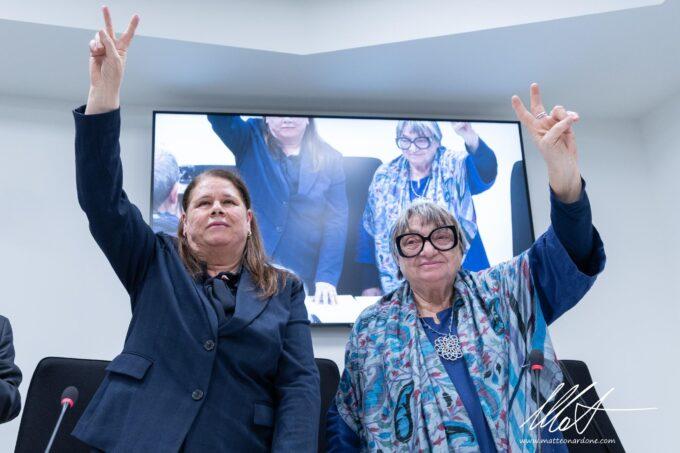
Many of these voices converged in Rome on January 21, 2026, at a powerful event in the Sala De Gasperi of the European Parliament offices. The presentation, led by Fadwa Barghouti—Marwan’s wife, lawyer, and tireless advocate—brought together a distinguished panel of powerful voices in cooperation with Assopace Palestina, the enduring organization led by Luisa Morgantini, whose decades-long dedication to Palestinian liberation made the gathering possible. The event was supported by Domenico “Mimmo” Lucano, the embattled current mayor of Riace renowned for his migrant solidarity work and now an MEP, along with other EU representatives. It launched and amplified the international campaign “Free Marwan Barghouti and All Palestinian Prisoners.”
Photograph by Matteo Nardone
Fadwa delivered a searing testimony on her husband’s condition—severe beatings that left him unconscious with broken ribs, prolonged solitary confinement since October 7, 2023, blocked family visits, and denied Red Cross access—while demanding urgent European intervention. Leoluca Orlando, who in 2014 became the first and only Italian mayor to grant Barghouti honorary citizenship in Palermo as a bold act of solidarity, reaffirmed that historic gesture as a stand for justice. Cecilia Strada brought the European dimension to the call for freedom and accountability, while the contributions of Yousef Salman, president of the Palestinian community of Rome, and Palestinian scholar and human rights activist Mohamed Allaham further deepened the discussion.
Fadwa Barghouti laid bare the grim reality facing Palestinians under occupation: “Within the context of international law, Palestinians don’t count. Palestinians are barely even given the right to survive—the West Bank situation is horrific and becoming worse by the day.” She further condemned the systematic denial of Palestinian agency, declaring: “Palestinians are experiencing a daily erosion and mockery of sovereignty.” In one of the most chilling moments, Fadwa recounted a direct encounter between her husband and National Security Minister Itamar Ben-Gvir: “Marwan has been in solitary confinement since October 7th. When Ben-Gvir visited Marwan’s cell he showed him an image of an electric chair and threatened that this is where he was going to be executed before the eyes of the world. Marwan responded that Gvir had become all grey and said ‘when are you going to mature as a politician to match your age?’ ‘There are still 8 million Palestinians living between the river and the sea, isn’t it time to sit down at a table and negotiate seriously for a just and lasting peace?'”
Fadwa also shared a recent update: just before her trip to Italy, an Israeli lawyer was finally able to meet with Marwan—marking one of the rare visits since October 7, 2023, as no family members or Palestinians other than fellow prisoners have been allowed to see him. The lawyer reported being amazed by Marwan’s strength and courage despite the ordeal. When asked if he wanted to file a complaint about prison conditions and the food (having lost around 12 kilos), Marwan responded that all the prisoners should be petitioned and only a joint complaint should be made. He said that his personal complaint was about access to books, as he is only allowed the three Abrahamic religious texts. Marwan is an avid reader who usually reads 8 books a month in three languages—English, French, and Arabic—reflecting an intellectual rich in culture, history, and political analysis.
Yousef Salman, president of the Palestinian community of Rome, spoke movingly of the universal demand behind the struggle: “Palestinians have never asked for the moon, we have only ever asked to be respected as human beings under the framework of international law and the charter of the United Nations.” This respect has never come.
Fadwa Barghouti closed with a message that resonated deeply: “If Palestinians achieve the justice and human dignity they deserve it won’t just be for Palestinians, but will be for all human beings struggling for dignity, freedom, justice and respect around the world. It will be a victory for all of humanity.” Her words gave renewed meaning to the saying “We are all Palestinians.”
Her testimony often left the room in stunned silence, exposing the raw intimidation and genocidal threats leveled at the man many see as Palestine’s future leader. Mimmo Lucano and Luisa Morgantini reinforced the call, emphasizing the need for Europe to act decisively against this erasure and to champion the release of Barghouti as a step toward justice and reconciliation. And Cecilia Strada, echoed the calls for an end to European complicity in Israeli crimes saying that she would cotinue to fight for an end to the hyporisy of Europe in the context of international law.
On January 21st, 2026, all the leaders from Italy’s left opposition parties – the Green Left Alliance, the 5 star Movement and the Democratic Party– stood united in calling for Marwan Barghouti’s freedom as a symbol of Palestinian unification and justice—only to be painted by right-wing media as “standing with terrorists,” a familiar and constant smear tactic designed to delegitimize any solidarity with Palestinians and the contsant strategy of the Zionist project.
Meanwhile, Israel’s far-right government, led by figures like Itamar Ben-Gvir, has only tightened the screws. Barghouti has endured severe beatings—as in September 2025 during a prison transfer—and prolonged solitary confinement. Family visits and Red Cross access are blocked, fueling fears for his life. Ben-Gvir has boasted of worsening conditions, while Netanyahu’s office quashed internal lobbying for his inclusion in exchanges. In recent weeks, Ben-Gvir has escalated his rhetoric to outright calls for executions of Palestinian prisoners, including by hanging. A Knesset bill advanced to its second and third readings in January 2026—introduced by his Otzma Yehudit party—explicitly mandates death by hanging for those convicted under military law, with Ben-Gvir celebrating progress by distributing sweets and wearing a golden noose pin. These proposals, condemned by International human rights groups as genocidal incitement, coincide with reports of over 110 prisoner deaths from torture and mistreatment under his watch since 2023.
This refusal of the Israeli state exposes the deeper truth: Barghouti threatens the status quo more than any militant. A Fatah stalwart with cross-faction credibility, he could bridge Gaza and the West Bank, sideline extremists, and negotiate from a position of authentic legitimacy. His release would force Israel to confront a Palestinian partner capable of ending the occupation through diplomacy which would force the world to seriuously confront its colonial and genocidal past. Instead, the regime clings to division, preferring a fractured enemy to a unified one while puhing the criminalization of dissent around the world.
In Italy, this repression is mirrored in a sharp escalation of state crackdowns on pro-Palestinian solidarity over the past few months. In December 2025, Italian authorities arrested nine people—including prominent Palestinian activist Mohammad Hannoun, president of the Palestinian Association in Italy—on suspicion of financing Hamas through charities, seizing millions in assets and sparking protests in Milan denouncing the operation as part of a broader “campaign of repression and criminalisation.” Earlier, in November 2025, Egyptian imam Mohamed Shahin in Turin faced arrest and deportation threats for his outspoken Gaza advocacy during rallies, prompting widespread demonstrations across cities like Turin, Milan, Genoa, Florence, and Naples. Police violence has intensified during mass protests, with clashes in Milan, Bologna, and Rome involving tear gas, water cannons, and arrests amid nationwide strikes and blockades in solidarity with Gaza. The Meloni government’s security decrees have further criminalized dissent, targeting road blockades and activism while deportations and visa restrictions hit migrants and organizers expressing Palestine solidarity. These measures, part of a wider European trend, aim to silence voices demanding justice—yet they have only fueled larger mobilizations, from general strikes to street actions in Rome, Milan, Bologna, and beyond.
Palestinians around the world have been inspired and given great hope by the scenes of millions in the streets across Italy and the world in a cry from below to end the genocide and create a just peace. As Fadwa repeated, “This movement of humanity and love gives us hope and renewed strength.”
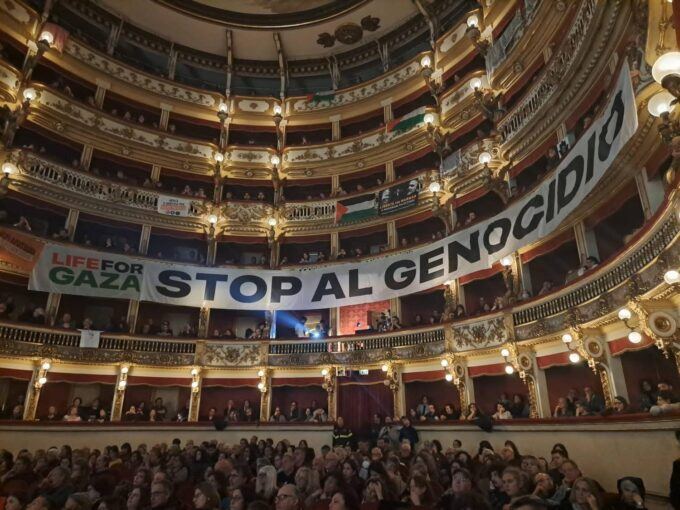
Solidarity events continue to swell across Italy, demonstrating the movement’s readiness to pour into the streets again as long as the genocide persists. On January 19, 2026, the historic Teatro Bellini in Naples was sold out for a powerful Life For Gaza event, where hundreds gathered to hear and view testimonies, poetry, artistic presentations and music in solidarity with the besieged population. On January 20th the historic cinema Adriano in Roma was sold out for a documentary screening with Adwa Barghout in attendance. These cultural and political gatherings—from packed theaters to spontaneous demonstrations—reflect the enduring Palestinian sumud (steadfastness) and the continuing Italian refusal to accept the ongoing slaughter.
The sweeping hypocrisy of Europe and the United States in the application of international law remains glaring. While Western capitals preach accountability and human rights in regards to Greenland and Ukraine, they arm Israel, veto UN resolutions, and remain silent on the daily killings in Gaza — especially after the so-called but non existant ceasefire. Palestinians continue to be murdered almost daily, including three journalists targeted and killed in a deliberate Israeli attack on January 21st. Donald Trump’s farcical “Board of Peace”—a collection of billionaire donors and hardline Zionists—has been trotted out as a supposed diplomatic breakthrough, yet it excludes Palestinians, offers no justice, no end to occupation, and no accountability for war crimes. It is theater, not peace.
The plight of Barghouti and thousands like him—arbitrarily detained, tortured and denied due process—mirrors the broader Palestinian condition under occupation. Their resilience is resistance, embodied in unbreakable sumud, and continuing to inspire global solidarity. As events like the Rome presentation led by Fadwa Barghouti and the sold-out Naples theater demonstrate, the demands are clear: first and foremost, stop the genocide; enforce international law and free the prisoners, starting with Marwan Barghouti. His freedom would not just end one family’s suffering; it could crack open the door to genuine peace.
Free Marwan Barghouti. Free them all. From the river to the sea, Palestine will be free.
Michael Leonardi lives in Italy and can be reached at michaeleleonardi@gmail.com
Nenhum comentário:
Postar um comentário