
Por Evaggelos Vallianatos
 |
Prologue
I learned a few things about Plato in high school and in my university classes on ancient and medieval Greek history. I improved that meager understanding of this great philosopher on my own: reading his dialogues in the original Greek and English translations.
The decisive influence of the Peloponnesian War on Plato
Plato, 428-348 BCE, grew up in Athens during the catastrophic civil war between the Greeks, the so-called Peloponnesian War, 431-404 BCE. This war marked the Greeks forever, seeding the ground with fear, antagonism and conflict. Eris, goddess of strife, rose from obscurity to prominence. The warnings of Homer, Aeschylos, Euripides and other poets, never to fight civil wars were set aside.
The other tragedy of the Peloponnesian War terminated half a century of unprecedented prosperity and scientific and artistic achievements, primarily in Athens, after the decisive victories of the Greeks of the invading Persian armies in the battles of 490 in Marathon, 480 in Salamis and Plataea in 479 BCE. Thucydides, who described the Peloponnesian War, was convinced that the fear of Sparta of the growing Athenian political power and civilization, triggered the conflict. Persia funded Sparta.
Alcibiades and Socrates
Plato grew up in the chaos of a democratic Athens fighting the Greek military superpower Sparta for 27 years. His teacher, Socrates, c. 470-399 BCE, was a soldier in the war. Socrates’ student Alcibiades, c. 450-404 BCE, like Plato, was a member of the upper class related to Pericles. But unlike Plato who remained faithful to Athens, Alcibiades was more than a rich, spoiled, handsome, but courageous young man with great political ambitions. He was elected a general in the Athenian army. He turned out to be a strategist of import. But his enemies in Athens charged him with impiety to the gods that forced Alcibiades to defect from the Athenian naval forces in Syracuse to Sparta, where he sought protection. He became a traitor. He gave state secrets to both Sparta and Persia. Plato even wrote Alcibiades, a dialogue, in which Socrates quizzed Alcibiades about the politics of war and peace, justice and the soul. They agreed on the virtue of the Delphic injunction on all Greeks: of knowing who they were (γνῶθι σ᾽αυτόν).
The birth of Plato’s dream
Plato wrote his dialogues after the end of the Peloponnesian War and the death of Alcibiades at the hands of Persians and Socrates at the hands of Democratic Athens. Certainly, the abhorrent behavior of Alcibiades during the Peloponnesian War influenced Plato. However, the collapse of order, the vengeance of Athenian democracy in putting to death Socrates, and the barbarian behavior of Athenians and Spartans slaughtering each other for 27 years shaped Plato and his philosophical and political views. He founded the Platonic Academy in 380 BCE with the hope the school might do some good. It did for almost 900 years, until, in 529, the Christian Roman emperor Justinian shut it down.
The most important work of Plato was Τhe Republic (Πολιτεία). This was a masterpiece of philosophical, political, metaphysical, ethical and legal thought. The heart of this treatise was justice (δικαιοσύνη) and the idea of the good, virtues almost identical, which incorporate all the other virtues of freedom, eusebeia (piety for the gods) and conviction that the gods were good and perfect, rightness, courage, and self-respect.
Book VII of the Republic explores these virtues in the allegory of the cave. The question is, is justice / the idea of the good feasible in both man and the state? Underlying this discussion was Plato’s disappointment with the state of civilization in Athens and Greece after the great carnage of the Peloponnesian War.
The allegory of the cave: justice and the idea of the good
His story of the cave is a metaphor capturing the fall and intellectual slavery of men, chained to a wall in a cave, viewing images on a wall in front of them. The images were made up behind them by other men with the assistance of a fire burning behind them. Plato has one of the prisoners escape and gradually taking the path to the surface of the cave, and, therefore, facing the reality of nature and the Sun in particular. For Plato, the post Peloponnesian War Greeks were the prisoners in his allegorical cave, the cave fire was the Sun. He equated the walking, the ascending prisoner to the land above the cave, to the rise of the soul to the world of ideas, knowledge and the idea of the good: source of justice, truth, light, reason and of all things beautiful.
The allegory of the cave speaks not merely of the corruption of the Greeks after their ferocious civil war, but of all humans struggling with themselves and their state. Is justice possible? Plato asks. And if it is, whom does justice benefit? The rich and well-connected? The poor? Was justice good to individuals alone or to both them and the state?
Justice, δικαιοσύνη, is a very broad virtue that Plato, rightly, makes it synonymous to good, αγαθόν or, better yet, Καλοκαγαθία / kalokagathia / beautiful and good, which derives from the popular maxim καλόν κ᾽ αγαθόν / beautiful and good / virtuous. Both justice and good demand perfection, which is why Plato made them embrace each other, including truth, reason, light and all things beautiful.
Inventing a state
With such high ethical standards for bringing justice down to the level of everyday life among the citizens of a polis, Plato, through Socrates, embarked to the invention of a new polis of justice. But who would rule such a polis? Certainly, not the democrats of Athens who had condemned his teacher, Socrates, to death for made-up charges of corrupting the youth. Who then? Plato starts with rulers he would choose from young age, educated in the virtues of government, ethics, poetry, music, gymnastics, and especially in the intelligence and knowledge and truth of mathematics (arithmetic, geometry, and astronomy). And to avoid the influence on the education of the young of potentially harmful ideas, myths, and lies, Plato endorses the censorship of Homer and other poets who, sometimes, relate fictional and insulting stories about the gods. Plato, like other philosophers, loved Homer as the teacher of the Greeks. But in his invention of a new polis, he became cautious. He was convinced the gods were good and perfect. So, he became cautious and stern with the poetry the young learned in school. After all, these young men and women were destined to rule the state. The rulers, Plato said, must also be courageous, strong and daring for defending the polis.
From philosopher kings to the rule of law
In addition, the rulers must be entirely trained in the theory and application of justice. This means, the rulers ought to be involved in dispensing justice without human biases that come with marriage, the ownership of property, luxuries and corruption. Thus, Plato imagined eugenics, rulers who had access to beautiful women, but who could not have families or the ownership of property.
Finally, Plato concluded that all his educational, musical, athletic, and mathematical training and protective measures in creating rulers fit for the administration of justice were bound to fail without philosophy. So, he raises the important question of philosophers kings for the perfect state he created for the triumph of justice. But even philosophers as the chief executives or despots or kings are by no means certain they can rule justly. This is because justice, as we have already suggested, was reason, truth, light, and beauty, that is, perfection. And no mater the training, wealth and power, humans are not perfect beings. Their soul, Plato said, once out of the cave, ascends to perfection: reason, truth, light, harmony and beauty.
Plato finally realized the dream-like virtues of his Politeia / Republic and he wrote The Laws, where he tried to make it easier the magnificent goal of justice in the Greek polis. But this time it was done through the traditional Greek political and governing function of citizen legislating laws that controlled human passions by empowering the logical part of the soul to help humans avoid extremes and moderate their actions. The Greeks published their laws on marble or stone, demanding that citizens and foreign visitors knew the decisions citizens had taken in their ecclesia / assembly.
Aristotle
We are fortunate that Aristotle, 384-322 BCE, was a student of Plato for 20 years. Not only Aristotle was a genius who invented science. He was also a classic polymath who captured Platonic thought as nobody else. Together, Plato and Aristotle, were the apotheosis of Hellenism. They built the most profound philosophical, political and ethical architecture of science and civilization.
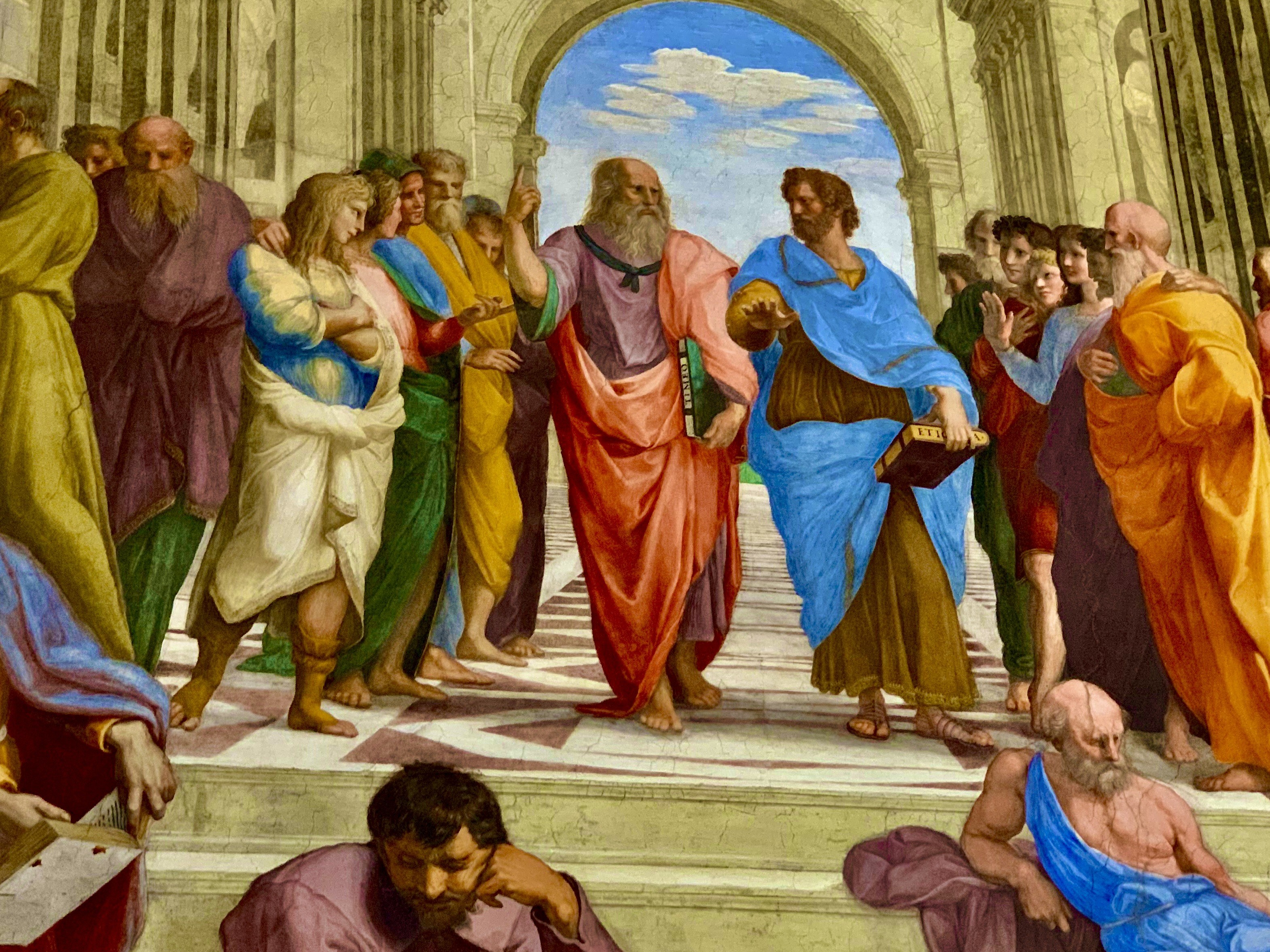 |
Plato and Aristotle in the midst of other Greek scholars. Plato points to heavens and Aristotle to the reality in front of him. School of Athens by Raphael, 1511. Vatican Museum. Kevin Moffett.
Epilogue
In fact, Aristotle complemented the idealistic edifice of Plato with a rigorous attention to observation of the natural and human world of light, the Greek poleis (city-states), despite corruption and strife. He also repeated Plato’s urgent appeals for the primacy of justice in political life in his works The Politics and The Nicomachean Ethics. Aristotle tutored Alexander the Great who conquered Persia and spread Hellenic learning worldwide. Aristotle also continued Plato’s thought about justice and the rule of law, a tradition that founded and influence Western societies to this very day. The law should be sovereign, Aristotle said in his Politics and law should be the master of the government, Plato underlined in his book, The Laws. These suggestions by Plato and Aristotle still move democracy the world over.
This wisdom of Plato and Aristotle is clearly timely in America. Justice must become the central focus of political life. And law needs to become the master of all, citizens and the president. Plato’s cave is very relevant in capturing our political predicament threatening the traditions of democracy we inherited from the Greeks.
Evaggelos Vallianatos, Ph.D., studied history and biology at the University of Illinois; earned his Ph.D. in Greek and European history at the University of Wisconsin; did postdoctoral studies in the history of science at Harvard. He worked on Capitol Hill and the US EPA; taught at several universities and authored several books, including The Antikythera Mechanism: The Story Behind the Genius of the Greek Computer and its Demise. He is the author of Freedom: Clear Thinking and Inspiration from 5,000 Years of Greek History (Universal Publishers, 2025).
Nenhum comentário:
Postar um comentário